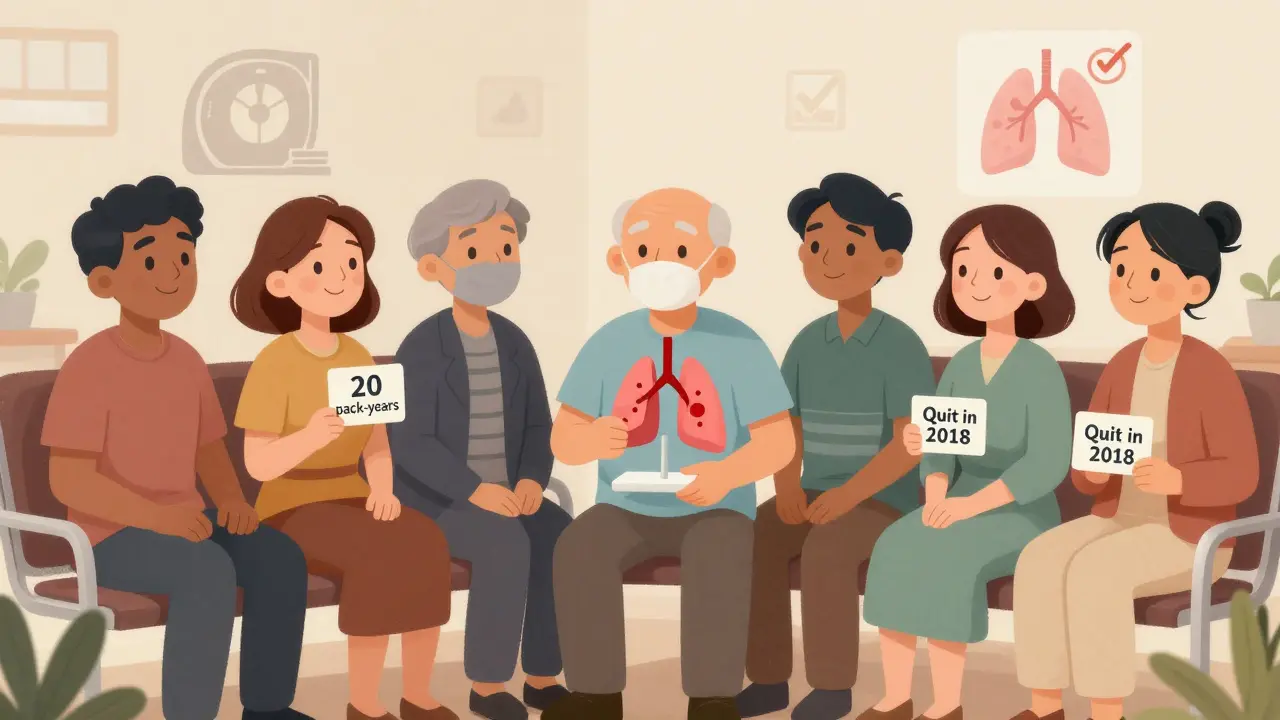
Every year, more people die from lung cancer than from breast, colon, and prostate cancer combined. And for smokers, the risk isn’t just high-it’s personal. But here’s the thing: if you’ve smoked for years, there’s a simple test that can catch cancer early, when it’s still treatable. It’s called low-dose CT, or LDCT. And it’s not just for people who smoked a pack a day for 30 years anymore. The rules changed in 2021, and now millions more people qualify. If you’re a current or former smoker between 50 and 80, you need to know what this means for you.
The old rule was simple: if you smoked at least 30 pack-years and were 55 or older, you got screened. But that left out a lot of people. The updated guidelines from the U.S. Preventive Services Task Force (USPSTF) in 2021 changed everything. Now, you qualify if you’re between 50 and 80, and you’ve smoked at least 20 pack-years. That’s not as much as you might think. One pack a day for 20 years? That’s 20 pack-years. Two packs a day for 10 years? Same thing. Even if you quit smoking, you’re still eligible if you stopped within the last 15 years.
Screening stops when you’ve been smoke-free for 15 years, or if you have other serious health problems that make surgery unlikely or too risky. It’s not a free pass for everyone who ever smoked-it’s targeted. The goal isn’t to screen everyone. It’s to find cancer early in the people who need it most.
It’s quick. It’s painless. And it doesn’t require any prep. You lie on a table, raise your arms, and hold your breath for a few seconds while the machine takes detailed pictures of your lungs. The whole thing takes less than 10 minutes. The radiation dose is about 1.5 millisieverts-roughly a third of what a regular CT scan gives you, and less than half the natural background radiation you get in a year from the environment.
Unlike a chest X-ray, which only shows the big picture, LDCT picks up tiny nodules-spots as small as a grain of rice-that might be cancer. That’s why it works. A 2011 study called the National Lung Screening Trial (NLST) proved it: people who got annual LDCT scans had 20% fewer deaths from lung cancer than those who got chest X-rays. That’s not a small win. That’s life-saving.
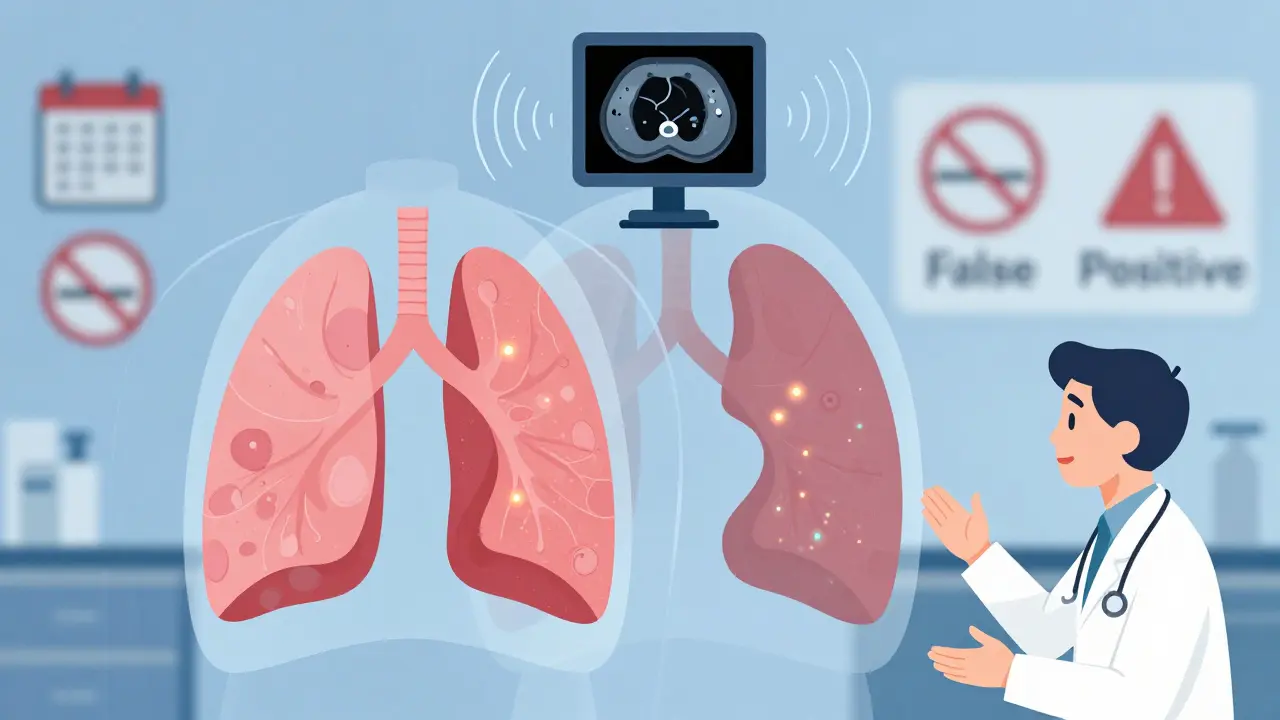
But here’s the catch: LDCT isn’t perfect. About 13.9% of people who get screened will get a result that looks suspicious-only to find out later it’s not cancer. These are called false positives. And they lead to more tests: another scan, a biopsy, sometimes even surgery. That’s stressful. A study in Cancer Epidemiology, Biomarkers & Prevention found that 37% of people with false positives had moderate to severe anxiety that lasted more than six months.
There’s also the risk of overdiagnosis. Some slow-growing cancers found by LDCT might never have caused harm. But once you see it on a scan, you’re likely to treat it. That means some people go through surgery, radiation, or chemo for a cancer that wouldn’t have killed them. It’s a real trade-off.
That’s why a pre-screening conversation with your doctor isn’t optional-it’s essential. Medicare requires it. The American Cancer Society insists on it. You need to understand the benefits, the odds of a false alarm, and what happens next if something shows up. It’s not just about getting the scan. It’s about being ready for what comes after.
Here’s the shocking part: even though 14.5 million Americans now qualify, only about 8.3% of eligible people got screened in 2022. That’s up from 5.7% in 2020, but still far too low. Why? Three big reasons.
First, most doctors don’t bring it up. A Health Affairs study found that 42% of eligible patients never got a recommendation from their provider. Second, many people don’t even know they qualify. Twenty-nine percent of those surveyed didn’t realize screening was available to them. Third, access is a problem. In rural areas, the nearest accredited screening center might be over 100 miles away. One Reddit user traveled 127 miles just to get scanned.
And it’s worse for Black Americans. Despite higher lung cancer rates, they’re 20% less likely to get screened than White Americans. That’s not just a gap-it’s a crisis.
Some places are getting it right. Academic medical centers screen 25-35% of eligible patients. Community clinics? Only 5-10%. What’s the difference? Structure. The best programs have nurse navigators who call patients, help them schedule, explain the process, and follow up. They use electronic alerts in patient records to flag eligible people. They track results using Lung-RADS, a standardized system that tells doctors exactly what to do with each scan result-whether it’s a normal follow-up in a year or an urgent biopsy.
Facilities also need to be accredited by the American College of Radiology (ACR). That means they meet strict standards for image quality, radiation safety, and reporting. Medicare only pays for scans done at these accredited centers. As of December 2023, there were only 1,842 ACR-accredited lung cancer screening sites in the U.S.-not nearly enough to cover every county.
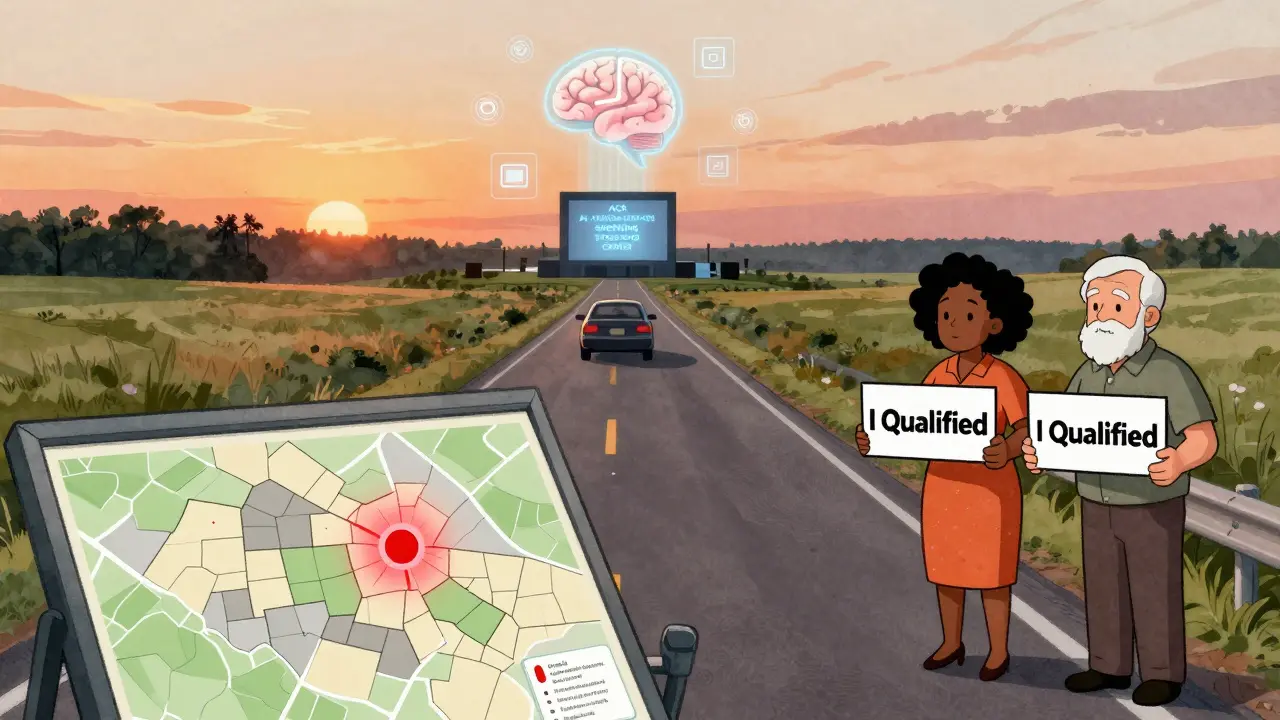
Screening isn’t standing still. New tools are coming. In September 2023, the FDA approved the first AI software for LDCT analysis-LungAssist by VIDA Diagnostics. In trials, it cut false positives by 15.2%. That’s huge. Less anxiety. Fewer unnecessary biopsies. More accurate results.
Another advance is better risk prediction. The old model just looked at pack-years. Now, researchers are using the PLCOm2012 model, which adds in family history, breathing problems, education level, and other factors. This could help identify who’s at the highest risk, so screening can be even more focused.
And the numbers keep growing. The U.S. lung cancer screening market was worth $1.27 billion in 2022. It’s expected to grow nearly 7% a year through 2030. That’s because more people are eligible, and more providers are learning how to do it right.
If you’re a current or former smoker between 50 and 80, and you’ve smoked at least 20 pack-years, talk to your doctor. Don’t wait for them to bring it up. Ask: "Am I eligible for lung cancer screening?" If they say no, ask why. If they say yes, ask about the next steps: Do I need a referral? Is the facility ACR-accredited? What happens if something shows up?
And if you’re still smoking-this is your moment. Screening won’t stop cancer. Quitting will. But if you’re not ready to quit yet, screening can still save your life. It’s not a substitute for quitting. It’s a safety net while you work on it.
One woman from the American Lung Association’s "Saved by the Scan" campaign said: "My stage 1 lung cancer was found during a routine screening at age 53 after 25 pack-years of smoking. I’m now 5 years cancer-free." That’s the power of this test. It doesn’t guarantee you’ll live longer. But it gives you a real chance.
You should consider screening if you’re between 50 and 80 years old, have smoked at least 20 pack-years (like one pack a day for 20 years), and currently smoke or quit within the past 15 years. Screening stops if you’ve been smoke-free for 15 years or if you have serious health issues that make treatment unlikely.
No. A low-dose CT (LDCT) uses about 1.5 millisieverts of radiation-much less than a standard CT, which can use 7 to 8 millisieverts. It’s designed to find small lung nodules without exposing you to high radiation. The image quality is still good enough to detect early cancer, but the dose is kept as low as possible.
About 1 in 7 scans will show something that looks abnormal-but most aren’t cancer. You’ll likely need a follow-up scan in 3 to 6 months, or sometimes a biopsy. Doctors use Lung-RADS, a standardized system, to decide the next steps based on the size and shape of the nodule. It’s designed to avoid unnecessary procedures while catching real cancers early.
Yes, Medicare covers annual LDCT screening for people aged 50 to 77 who meet the smoking criteria. You need a referral from your provider after a shared decision-making visit. The scan must be done at an ACR-accredited facility. Coverage doesn’t extend to people over 77, even if they qualify under USPSTF guidelines.
Yes. In 2023, the FDA cleared the first AI tool for LDCT analysis called LungAssist by VIDA Diagnostics. In trials, it reduced false positives by 15.2%, meaning fewer people get called back for unnecessary follow-ups. It doesn’t replace radiologists-it helps them spot things faster and more consistently.
Three main reasons: most doctors don’t offer it, many patients don’t know they qualify, and access is limited. In rural areas, the nearest screening center might be over 100 miles away. Black Americans are 20% less likely to be screened than White Americans, even though they have higher lung cancer rates. Awareness and equity are still major barriers.
For high-risk smokers, yes. The radiation from one LDCT scan is very low-about the same as a mammogram. The benefit of catching cancer early far outweighs the small risk from radiation. Studies show annual screening reduces lung cancer deaths by about 20%. The real risk isn’t the scan-it’s not getting screened at all.




14 Responses
I got my LDCT last year after my cousin died of stage 4. It was scary, but the tech was chill as hell. Just lay there, held my breath, and boom-done in 7 minutes. No needles, no fasting, no drama. My doc didn’t even mention it until I brought it up. 😔
Let’s be real-this is just another way for Big Radiology to make money. They’ll scan everyone who breathes and then scare them into biopsies. False positives are a scam. My uncle had 3 follow-ups for a nodule that turned out to be scar tissue from a 20-year-old pneumonia. He lost 6 months of his life to anxiety.
I’m 52, smoked 1.5 packs a day for 18 years, quit 10 years ago. My doctor said I don’t qualify because I’m under 20 pack-years. But I read the guidelines-18 years at 1.5 is 27 pack-years. He didn’t know what he was talking about. I’m going to another clinic. This is wild.
So now we’re scanning people who smoked 20 years? What’s next? Scanning people who breathed air near a smoker? Next thing you know, we’ll be screening for ‘potential future smoker lung’.
20% fewer deaths? That’s not a win-that’s a miracle. My grandma got screened at 54, caught it at stage 1, had a lobe removed, and now she hikes every weekend. Don’t wait for symptoms. Symptoms = too late.
The ethical imperative to provide equitable access to lung cancer screening cannot be overstated. Disparities in screening rates among Black Americans reflect systemic failures in healthcare delivery, not individual negligence. Policy interventions must prioritize infrastructure investment in underserved communities to ensure that life-saving technology reaches those who need it most.
It’s fascinating how the medical establishment has suddenly discovered that smoking causes cancer-after 70 years of denying it. Now they want to scan us? Brilliant. Let’s fix the symptom instead of the cause. Meanwhile, Big Tobacco is still sponsoring youth vaping campaigns. How’s that for a public health win?
USA always want to scan everyone. In Nigeria, we just pray and take herbs. Why you spend money on machine when God give you body? And why you think scan help? Maybe it make cancer spread. I hear this from my cousin who work in hospital in Lagos. They say scan make people panic and die faster.
If you’re reading this and you’re eligible-please, don’t hesitate. Talk to your doctor. Bring this article with you. Ask for a referral. You don’t need to be perfect to deserve this test. You just need to be alive. And you’re worth it.
I’m 58, smoked 2 packs a day for 15 years = 30 pack-years. Quit 8 years ago. My doc said ‘you’re good’ and didn’t even mention LDCT. So I went to a private clinic. They charged me $450. Medicare won’t cover it until 77? That’s a joke. We’re paying for a system that’s broken, slow, and racist. And they wonder why people don’t trust medicine.
I just got my first LDCT last week and I’m so glad I did 😊 My doc actually brought it up-rare! They used Lung-RADS and said everything looked normal. But I cried after. Not because I was scared-but because I realized how many people never get this chance. If you’re eligible, please don’t wait. 💙
The fact that AI is now being used to reduce false positives is a monumental leap forward. The integration of machine learning into diagnostic radiology represents a paradigm shift in preventive medicine. While some may fear automation, the data clearly shows that AI-assisted interpretation increases diagnostic accuracy without compromising human oversight. This is not the future-it’s the present.
I didn’t know I qualified until I read this. I smoked for 12 years, quit 10 years ago. 1 pack a day for 12 is 12. Then I smoked half a pack for 8 more years-that’s 4 more. Total 16. But I’m 51. Guess I don’t qualify. Still, I’m gonna ask my doctor anyway. Can’t hurt to ask.
I just saw Celia’s comment. Same here. I cried too. Not because I was scared-but because I realized how many people never get this chance. My mom didn’t make it because she never got screened. I didn’t want my kids to lose me the same way.