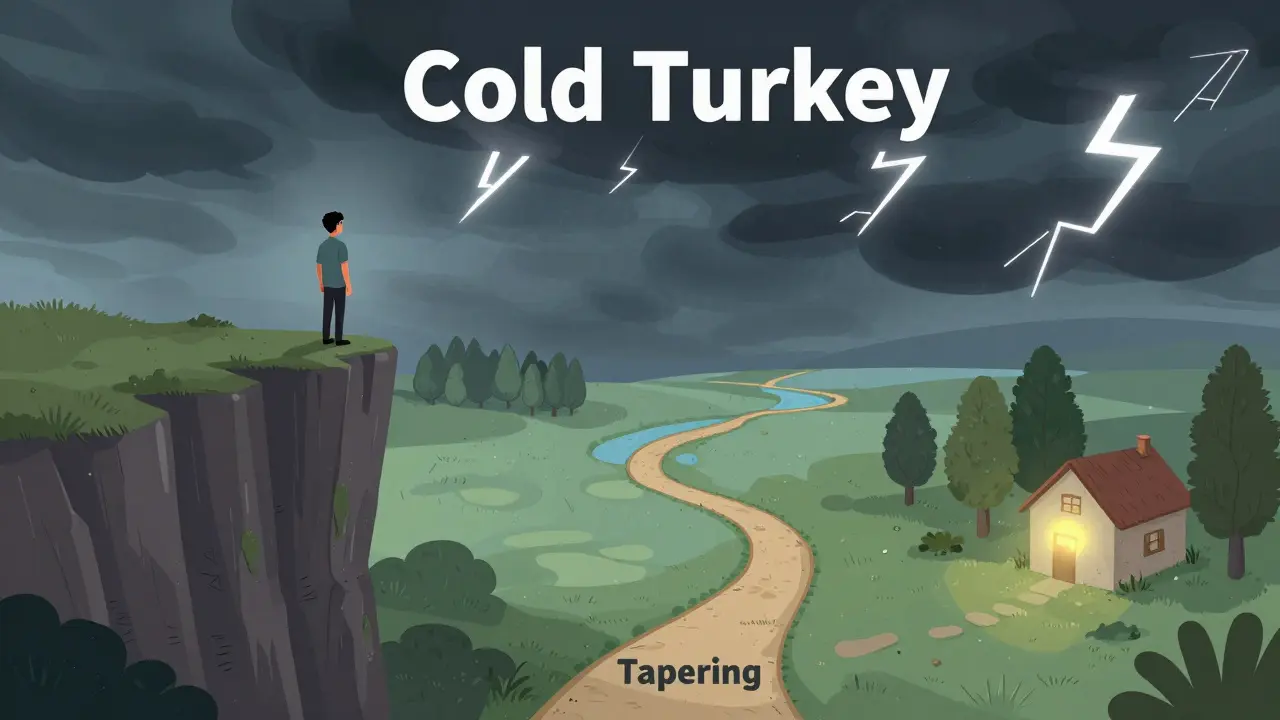
Stopping benzodiazepines cold turkey can be dangerous. For people who’ve taken these medications for weeks or months-especially at higher doses-abruptly quitting can trigger seizures, severe anxiety, hallucinations, or even life-threatening complications. The good news? You don’t have to quit suddenly. With the right plan, most people can safely reduce their dose over time and regain control without overwhelming withdrawal symptoms.
The Joint Clinical Practice Guideline on Benzodiazepine Tapering (a 2024 consensus document developed by 10 medical societies including psychiatry, family medicine, and addiction specialists) makes it clear: tapering isn’t optional for long-term users. It’s the standard of care. In fact, the FDA updated drug labels in 2019 to warn prescribers about the risks of sudden discontinuation. Today, 28 U.S. states require a formal tapering plan for prescriptions longer than 90 days.
Why now? Because the numbers don’t lie. In 2022, over 30 million Americans used benzodiazepines. Nearly 1 in 5 of them used them long-term-more than 120 days. And for older adults, the risks are even higher. Benzodiazepines double the chance of falls, worsen memory, and increase the risk of car accidents. The Beers Criteria, used by doctors nationwide, lists these drugs as potentially inappropriate for seniors.
The most widely supported approach is a 5% to 10% reduction every 2 to 4 weeks. That means if you’re taking 10 mg of diazepam daily, you’d drop by 0.5 to 1 mg every few weeks. This slow pace lets your nervous system adjust without triggering severe symptoms.
But duration matters too. The Oregon Health Authority recommends:
Why such a wide range? Because some people feel fine with a faster taper, while others need more time. If you start feeling worse-insomnia, shaking, panic attacks, or brain zaps-you slow down. The goal isn’t to rush. It’s to finish without relapse.
Here’s how it works: your doctor calculates an equivalent dose. For example:
| Original Medication | Equivalent Diazepam Dose |
|---|---|
| 1 mg alprazolam (Xanax) | 20 mg diazepam |
| 1 mg lorazepam (Ativan) | 10 mg diazepam |
| 0.5 mg clonazepam (Klonopin) | 10 mg diazepam |
Once switched, you taper diazepam slowly. Its long half-life means it stays in your body longer, smoothing out the dips that cause withdrawal. This method is especially helpful for people who’ve been on multiple daily doses or high amounts.
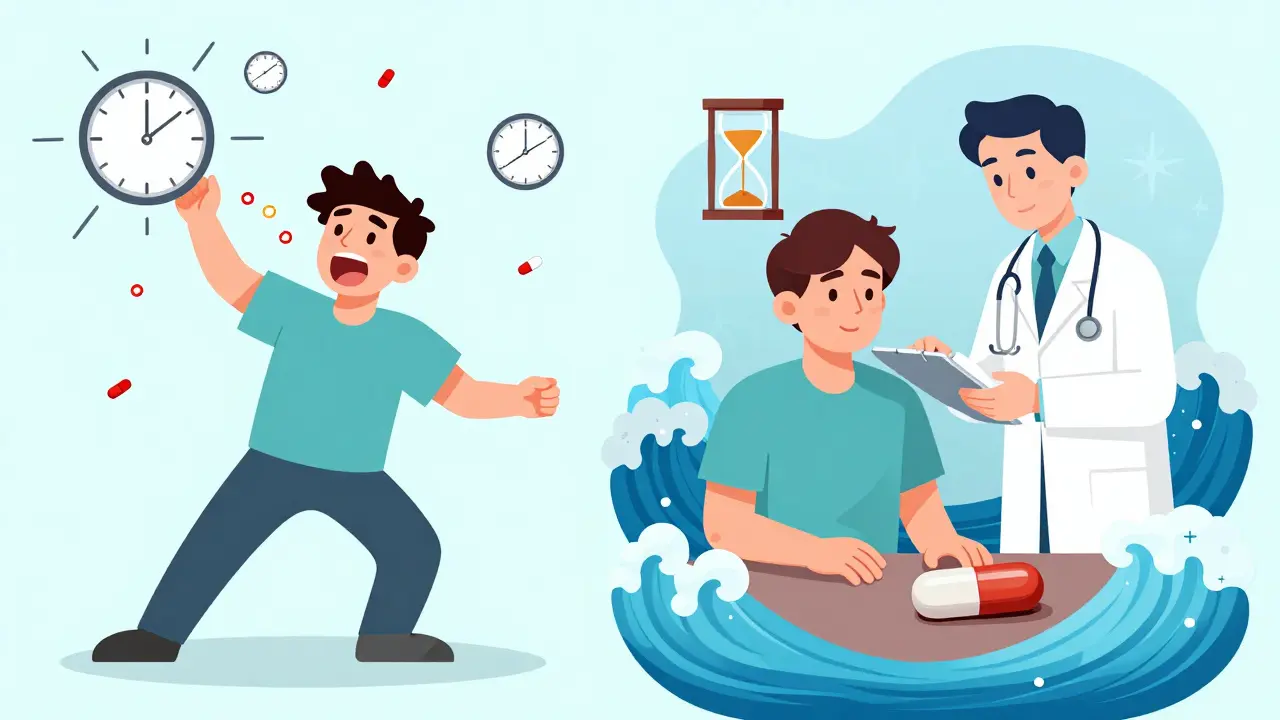
Important: No medication should be added just to mask withdrawal. The goal is to reduce dependence, not swap one drug for another. Always work with a provider who understands tapering protocols.
But even then, the goal is to use the lowest possible dose for the shortest time. For most, especially older adults and those with PTSD or substance use disorders, continuing benzodiazepines carries more risk than benefit.
The VA, for example, calls long-term benzo use in veterans with PTSD a “high-risk practice.” Studies show those who taper with therapy have better long-term outcomes than those who stay on medication.
Many people feel anxious just thinking about tapering. That’s normal. Anticipatory anxiety-fearing what’s coming-is often worse than the actual withdrawal. That’s why therapy and coaching are so important.
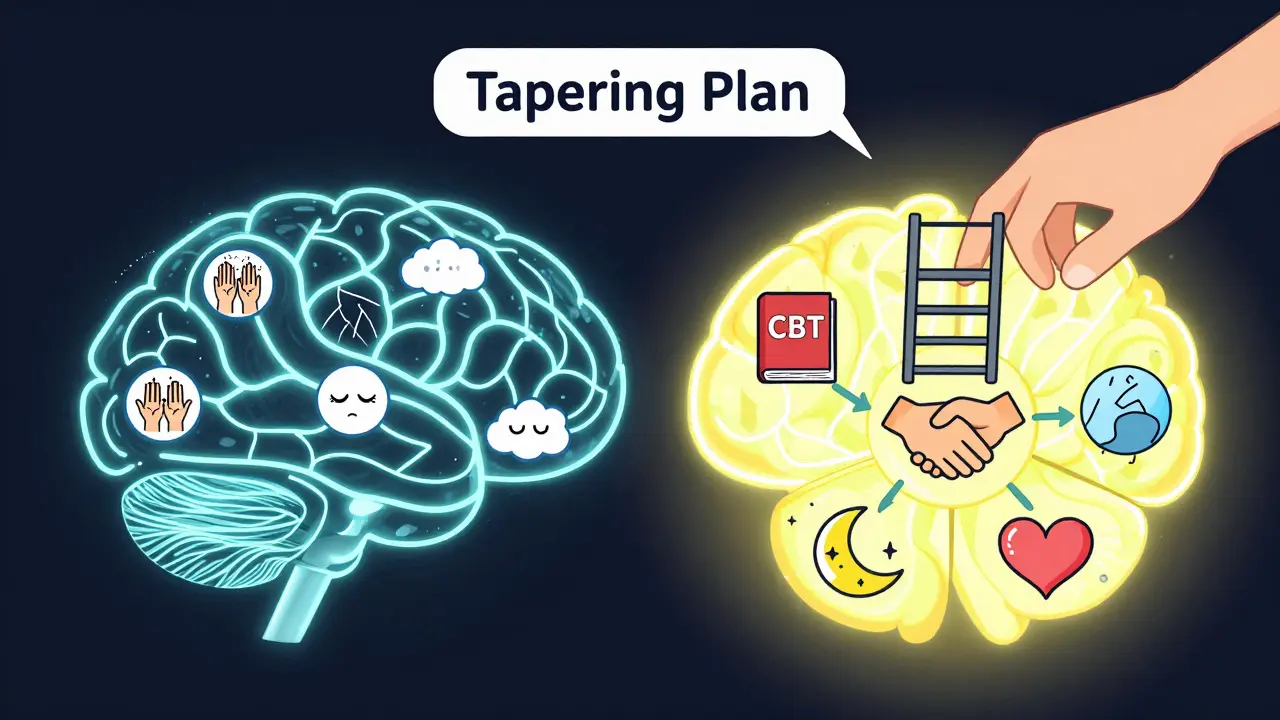
If symptoms are mild, you might just need to slow the taper. If they’re severe-seizures, hallucinations, or extreme agitation-contact your provider immediately. Never try to push through dangerous symptoms.
Keep a daily log. Note your dose, mood, sleep, and symptoms. This helps you and your doctor spot patterns. A 2024 NIH-funded study is testing a mobile app that uses this data to suggest real-time adjustments. In the meantime, paper logs work just fine.
By 2026, demand for specialists in this area is expected to rise 35%. Digital tools are coming-apps that track symptoms, remind you to reduce doses, and connect you to therapists. But the core hasn’t changed: slow, supported, individualized tapering still works best.
It’s not a race. Some people finish in 3 months. Others take 18 months. Both are valid. The goal isn’t to be done quickly. It’s to be done safely-and stay done.
No. Stopping abruptly after regular use-especially for more than a month-carries serious risks including seizures, psychosis, and even death. Even if you feel fine, your nervous system may be dependent. Always taper under medical supervision.
Acute withdrawal usually peaks within 1-4 weeks after the last dose and can last up to 6-8 weeks. Some people experience protracted symptoms-like sleep issues, anxiety, or brain fog-for months. These are not signs of relapse, but of healing. Patience and support are key.
Yes-in fact, it’s often recommended. Older adults are at higher risk for falls, memory loss, and car accidents from benzos. The Beers Criteria lists them as potentially inappropriate for seniors. Tapering reduces these risks significantly. Start slow, monitor closely, and involve a caregiver if needed.
Relapse doesn’t mean failure. Many people need to pause or slow down. The key is to avoid guilt. Talk to your provider, reassess your plan, and consider adding therapy or support groups. Most people who taper successfully have tried multiple times before finding the right pace.
Yes, but your chances of success drop significantly. Studies show only about 42% of people complete tapering with medication alone. With CBT or peer support, that number jumps to nearly 70%. Therapy helps you build coping skills so you don’t go back to the pill when stress hits.
Yes. SSRIs (like sertraline or escitalopram), SNRIs (like venlafaxine), buspirone, and certain anticonvulsants (like gabapentin) are often used for long-term anxiety. But they don’t work fast. That’s why benzos are prescribed initially. The goal of tapering is to replace short-term relief with long-term strategies like therapy, exercise, and stress management.
If you’ve been on benzodiazepines for a long time, you’re not alone. And you don’t have to stay on them forever. With the right plan, support, and time, many people find freedom-not just from the drug, but from the fear that came with it.





13 Responses
Tapering worked for me after 5 years on Xanax. Went 5% every 3 weeks with diazepam swap. No seizures, no hospital trips. Just slow and steady. Your brain forgets how to chill without drugs, but it learns again. Trust the process.
I tried to taper alone because my doctor said 'it's not that hard'-turns out it was a nightmare. Night terrors, heart palpitations, felt like my bones were vibrating. Don't do it without support. Therapy isn't optional, it's survival.
I have to say, as someone who has studied neuropharmacology at the graduate level and worked in a clinical research unit for over a decade, the data presented here is not only accurate but remarkably understated. The physiological adaptations to chronic benzodiazepine exposure involve GABA-A receptor downregulation, glutamate excitotoxicity, and HPA axis dysregulation-all of which necessitate a neuroadaptive window far beyond what most clinicians are trained to recognize. The 5-10% every 2-4 weeks guideline? That's the bare minimum. For many, 2-3% monthly is more appropriate, especially with polypharmacy or comorbid neurological conditions. And yes, the Valium switch is gold standard-not because it's 'easier,' but because its half-life permits pharmacokinetic smoothing. Also, melatonin? Useless. Trazodone? Fine if you're not on SSRIs. But nothing replaces structured CBT with a clinician who understands interoceptive exposure.
This is all a cover-up. Big Pharma made benzos so addictive on purpose. They know people get hooked, then they sell you SSRIs, therapy, apps, and supplements. The FDA? Controlled. The VA? A puppet. They want you dependent on systems, not free. I tapered off in 3 weeks with CBD and prayer. No one told you that. They want you scared. Don't believe the narrative.
Let me be perfectly clear: if you are taking benzodiazepines for longer than 30 days without a documented, evidence-based behavioral intervention, you are not 'managing anxiety'-you are self-sabotaging. This isn't a medical issue; it's a moral one. You have agency. You have free will. You chose this dependency. Now you want a handout? The science is clear: 70% success with CBT. Why aren't you doing the work? Stop looking for chemical crutches and start building resilience. You're not broken-you're lazy.
Switching to diazepam is the smartest move for long-term users. I’ve seen it work in clinic after clinic. The key is patience. People think they’re failing when they feel jittery-that’s just the nervous system recalibrating. Don’t rush. Don’t panic. Just keep the log. The body knows what to do if you let it.
I read this whole thing. Honestly? Most of it’s common sense. But the part about 'peer support' and 'VA programs'? That’s just government padding. Real recovery doesn’t need a group chat or a specialist. Just quit. Build discipline. You think your brain needs a 18-month taper? It needs a kick in the ass. I did it in 6 weeks. No therapy. No meds. Just willpower. Stop overcomplicating it.
This article reads like a TED Talk written by a pharmaceutical ethics committee. I mean, really-'regain control'? 'Freedom from fear'? Please. This isn't healing. It's a performance. The real tragedy isn't dependence-it's that we’ve turned a physiological adaptation into a moral crusade. You don’t need a 10-society consensus to tell you to taper. You need a quiet room, a journal, and the courage to sit with your own silence. And no, I didn’t use therapy. I used silence. And it worked.
The GABAergic recalibration window is non-linear and highly individualized. What we're seeing in longitudinal studies is that neuroplasticity peaks around week 12 of tapering, which is why the 6-18 month window for chronic users isn't arbitrary-it's neurobiological. Also, propranolol isn't just for tremors; it dampens adrenergic hyperactivity during the glutamate surge. And yes, fluoxetine’s long half-life helps as a pharmacological buffer, but only if you’re tapering below 10mg diazepam equivalent. Don’t forget the circadian component-sleep hygiene is 40% of success. Track your REM latency. It tells you more than any symptom checklist.
I tapered off Klonopin after 7 years. Took 14 months. Used the 5% method. Logged everything. Had a therapist. Got a dog. Walked every morning. No magic. Just consistency. 🙏
This is why the deep state wants you docile. Benzos are a control tool. They keep you quiet, compliant, and distracted from the real issues-corporate greed, surveillance capitalism, the erosion of personal autonomy. The 'tapering guidelines'? Designed to make you dependent on the system. Don't fall for it. Go raw. Cold turkey. Let your body scream. It's the only way to break the programming.
I was on 2mg Xanax daily for 3 years. Tried to quit cold turkey once-woke up in ER with a 104 fever and hallucinating my cat was a demon. Never again. Switched to diazepam, dropped 1mg every 3 weeks. Took 11 months. Had panic attacks. Cried a lot. But I’m sober now. And honestly? I feel more alive than I did on the pills. You got this.
Just stop. Seriously. You don't need a chart. You don't need a therapist. You just need to say 'no' one day at a time. I did it. You can too. 💪