
When you feel bloated, swollen, or like your stomach is about to burst, it’s not just uncomfortable-it can be embarrassing and disruptive. Whether you’re after a quick fix before a meeting or trying to enjoy a bean chili without regret, over-the-counter (OTC) gas and bloating remedies are one of the most common solutions people reach for. But not all of them work the same way. Two main types dominate the shelves: simethicone and enzyme products. Understanding how each works can help you choose the right one-or even use them together.
Simethicone isn’t a magic pill that stops gas from forming. It doesn’t kill bacteria, alter your digestion, or reduce the amount of gas your body makes. Instead, it tackles gas the way a dish soap breaks up grease. Think of gas bubbles in your gut like tiny soap bubbles. Left alone, they cling together, creating pressure and discomfort. Simethicone is a silicone-based compound that lowers the surface tension of those bubbles, making them merge into larger ones. Bigger bubbles are easier to pass-either as a belch or a flatulence. It’s a physical, not chemical, change.
First approved by the FDA in 1952, simethicone has been used for decades because it’s incredibly safe. It doesn’t get absorbed into your bloodstream. It stays in your gut, does its job, and exits unchanged. That’s why it’s safe for pregnant women, babies, and people on multiple medications. You’ll find it in brands like Gas-X (125mg per softgel), Mylicon (20mg/mL for infants), Phazyme, and Mylanta Gas Relief. Dosing is simple: 40-125mg after meals or when symptoms hit, up to four times a day. The maximum daily dose is 500mg.
Studies show relief within 15-30 minutes. A 2021 study in the Journal of Gastroenterology found simethicone provided symptom relief in 73.5% of users. Real-world feedback backs this up: Gas-X has over 18,700 Amazon reviews with a 4.5/5 rating, and many users call it a “lifesaver” for travel, meals, or sudden discomfort. But here’s the catch-it doesn’t prevent gas. If you eat a big plate of broccoli and then take simethicone, you’ll still produce gas. It just helps you get rid of it faster.
Enzyme products take a completely different approach: they stop gas before it starts. Instead of helping you expel gas, they break down the foods that cause it.
The two most common enzymes in OTC products are lactase and alpha-galactosidase. Lactase breaks down lactose-the sugar in milk and dairy. If you’re lactose intolerant, your body doesn’t make enough of it. That’s why dairy gives you gas, cramps, and bloating. Products like Lactaid, Dairy Digest, and generic lactase supplements provide the missing enzyme. You take them right before eating dairy. When done right, they prevent symptoms in up to 85% of users, according to the World Journal of Gastroenterology.
Alpha-galactosidase is the enzyme in Beano. It breaks down complex sugars found in beans, lentils, cabbage, broccoli, and Brussels sprouts. These sugars-called oligosaccharides-are indigestible by human enzymes. When they reach your colon, gut bacteria ferment them, producing hydrogen and methane gas. Beano gives you the enzyme your body lacks, so the sugars get digested earlier, before they reach the bacteria. You need to take it 5-10 minutes before eating, or it won’t work.
But effectiveness isn’t guaranteed. A 2020 study in the American Journal of Gastroenterology found alpha-galactosidase works in only 45-78% of people, depending on their gut bacteria and the specific food. One person might swear by Beano with beans, but it does nothing for their broccoli. That’s why many users say it’s hit-or-miss.
| Feature | Simethicone | Enzyme Products (Lactase/Alpha-Galactosidase) |
|---|---|---|
| How it works | Breaks up gas bubbles for easier expulsion | Breaks down food components before bacteria ferment them |
| When to take | After meals or when symptoms appear | 5-10 minutes BEFORE eating trigger foods |
| Speed of relief | 15-30 minutes | Prevents symptoms; no relief once gas forms |
| Effectiveness | 73.5% for symptom relief | 85% for lactose; 45-78% for beans |
| Prevents gas? | No | Yes, if taken correctly |
| Best for | Sudden bloating, unknown triggers, travel | Known food triggers (dairy, beans, cruciferous veggies) |
| Side effects | None reported in 92% of users | Generally safe; rare allergic reactions |
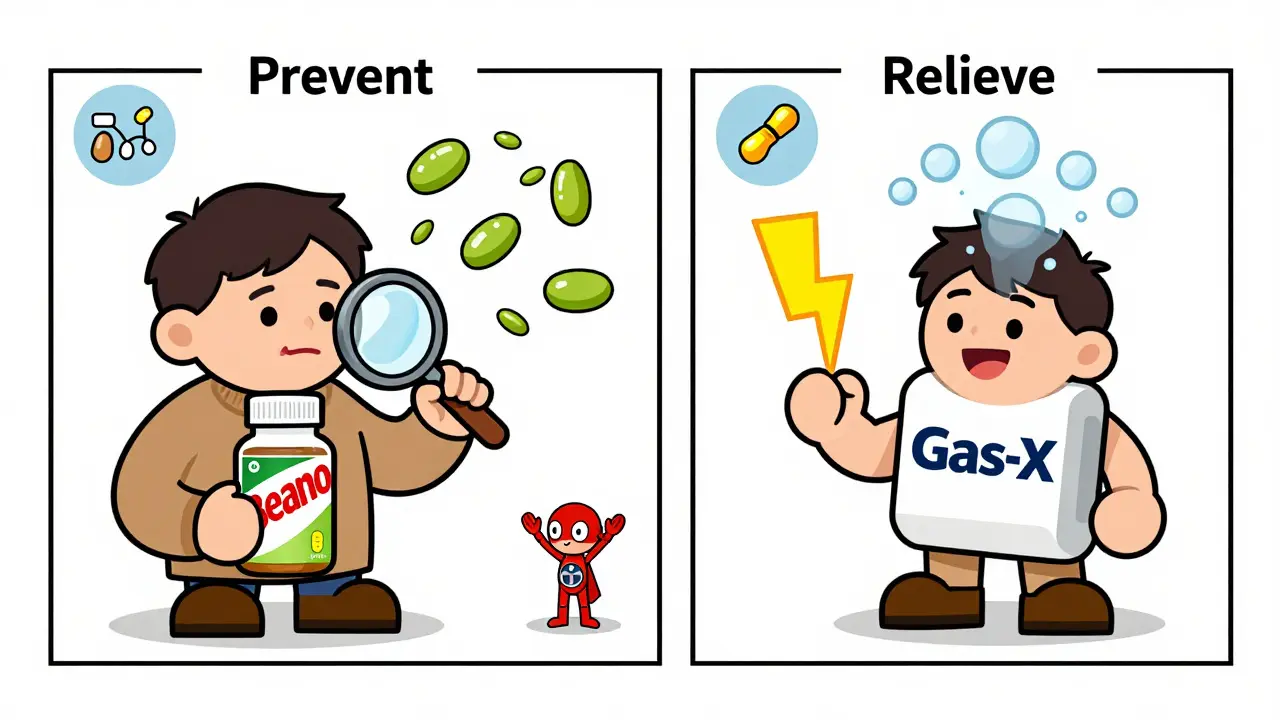
If you get bloated after eating just about anything, or if you can’t pinpoint what’s causing it, simethicone is your best bet. It’s the go-to for emergency relief. Think airplane rides, holiday meals, or sudden discomfort after lunch. It’s the “emergency button” for gas pain.
If you know exactly what triggers your gas-say, milk, cheese, or beans-then enzyme products are more powerful. Lactase is highly effective for dairy intolerance. Beano can be life-changing if you love beans but hate the aftermath. But you have to remember to take them before the meal. Forgetting means no protection.
Many people use both. One Reddit user put it well: “Simethicone is my emergency button for gas pain, but I use Beano preventatively when I know I’ll be eating problematic foods-they work best as a team.” That’s smart. Use enzymes to prevent, and simethicone to clean up the leftovers.
The National Institute of Diabetes and Digestive and Kidney Diseases (NIDDK) rates simethicone as “Recommended” with Level A evidence for symptomatic relief. Dr. Michael Camilleri from Mayo Clinic calls it the “gold standard” for immediate relief. The FDA and other regulatory bodies agree: it’s safe, effective, and reliable.
But experts also warn against overestimating it. Dr. Eamonn Quigley, editor of the American Journal of Gastroenterology, points out that simethicone doesn’t reduce gas volume-it just makes bubbles easier to pass. Marketing often implies it prevents gas, but that’s misleading. The FDA even updated guidelines in April 2023 to ban such claims.
Enzyme products get more nuanced reviews. Lactase is “Strongly Recommended” for lactose intolerance. But alpha-galactosidase? Only “Conditionally Recommended” because it doesn’t work for everyone. Research from Dr. Pankaj J. Pasricha found simethicone offered no real benefit over placebo in IBS patients with chronic bloating. That suggests it’s not a cure-all for underlying digestive disorders.
Amazon reviews tell a clear story. Gas-X (125mg, 200-count) has 78% of its 5-star reviews saying “immediate relief” or “works when nothing else does.” Travelers love it. Parents use Mylicon for colicky babies. But some users say, “It doesn’t help if you’re already extremely bloated.” That’s because simethicone doesn’t reduce gas production-it just helps move what’s already there.
Beano has a 4.2/5 rating. 68% of positive reviews say, “Essential for bean dishes.” But 41% of negative reviews say, “Didn’t work for me.” Same with Lactaid: 85% of lactose-intolerant users report success. The difference? Timing. If you take Beano after your chili, it won’t help. If you take simethicone after, it might.
Price matters too. A 100-count bottle of Beano costs around $18.99. A 200-count bottle of Gas-X is $12.49. For occasional users, simethicone is cheaper. For regular bean lovers, Beano pays for itself.
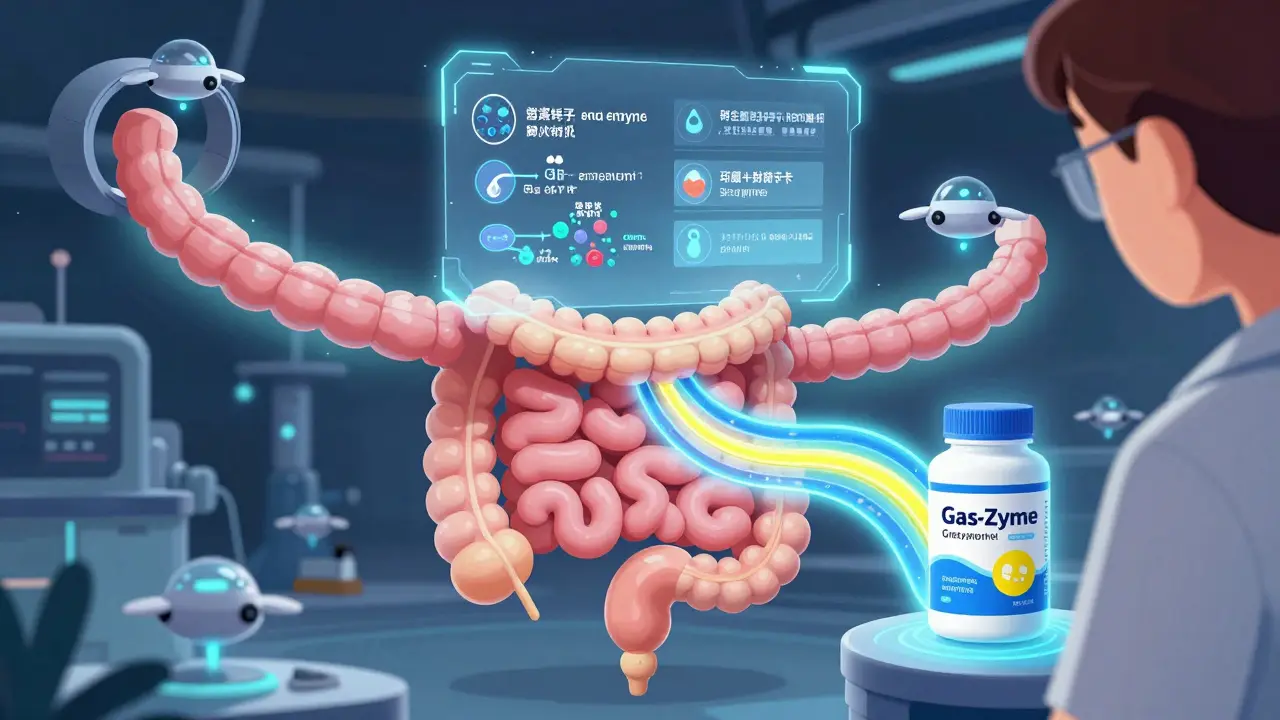
The market is evolving. Combination products-simethicone plus enzymes-are growing fast. Gas-Zyme, for example, saw 18.7% sales growth in 2023. It’s a smart hybrid: prevent with enzymes, clear with simethicone.
Next-gen formulations are in the works. Entero Therapeutics completed Phase 2 trials for a microencapsulated simethicone that lasts 8 hours instead of 2-3. That could mean one dose for an entire meal or travel day.
Personalized medicine is coming too. Viome’s gut microbiome test, launched in September 2023, now recommends specific enzyme products based on your unique bacteria. Imagine knowing exactly which foods trigger your gas-and which enzyme to take. That’s the future.
OTC gas remedies are great for occasional discomfort. But if you’re bloated every day, have persistent pain, changes in bowel habits, or unexplained weight loss, you’re not just dealing with gas. You might have IBS, SIBO, celiac disease, or another condition. These pills are a band-aid, not a cure. Dr. Robynne Chutkan’s book The Great Gas Fix argues that long-term reliance on these products can delay finding the real root cause.
Before you keep popping pills, ask: Is this happening after every meal? Do certain foods always trigger it? Have you tried cutting out common culprits like onions, garlic, carbonated drinks, or artificial sweeteners? Sometimes, the answer isn’t in the medicine cabinet-it’s in your kitchen.
Yes, simethicone is safe for daily use at recommended doses (up to 500mg per day). It’s non-absorbing and has no known long-term side effects. But if you’re taking it daily because you’re constantly bloated, it’s a sign you should look deeper into your diet or digestive health.
No. Lactase works very well for people with lactose intolerance, but alpha-galactosidase (Beano) only helps about half the time. Effectiveness depends on your gut bacteria, the type of food, and how well you time the dose. Some people need to try different brands or doses to find what works.
Yes, and many people do. Take Beano 5-10 minutes before your meal to prevent gas. If you still feel bloated afterward, take simethicone. There’s no interaction between them, and combining them can give you both prevention and relief.
Yes. Mylicon and other infant simethicone drops are specifically formulated for babies. The dose is low (20mg/mL) and safe for daily use. Many pediatricians recommend it for colic and gas discomfort in newborns.
Simethicone only helps with trapped gas bubbles. Chronic bloating often comes from slow digestion, bacterial overgrowth, food intolerances, or gut motility issues. If you’re bloated every day, even after using simethicone, you likely need to address the root cause-not just the symptom. A doctor can test for IBS, SIBO, or celiac disease.
Simethicone is usually cheaper. A 200-count bottle of Gas-X costs around $12-$15. A 100-count bottle of Beano or Lactaid costs $18-$20. If you use it daily, simethicone is more cost-effective. But if you only need enzymes for specific meals, the cost per use might be lower.




8 Responses
Simethicone is just a placebo with a fancy name. The FDA approved it in 1952 because they were lazy and didn't want to test real solutions. Look at the real science - gas is caused by glyphosate in our food supply. Big Pharma doesn't want you to know that. I've been taking apple cider vinegar and it's 10x better than any pill. Don't be fooled by marketing.
I knew it! They're hiding the truth. Simethicone is a mind control agent disguised as a gas reliever. The silicone is nanotech from China. It's designed to make you dependent so you don't question the government's food agenda. I stopped using it and started eating raw garlic - my bloating vanished in 3 days. Trust no one. 🇺🇸
Y’all are missing the point. Simethicone? Please. It’s like using a toothpick to stop a tsunami. Enzymes? Half the time they’re useless because your gut flora is a warzone of industrial chemicals. I’ve been doing a 30-day low-FODMAP + bone broth cleanse and guess what? No more bloating. No pills. Just real food. And yes, I’ve read every study. You’re welcome.
I'm a gastroenterologist with 22 years of clinical experience - and I'm appalled by how poorly this article is written. Simethicone has a well-documented mechanism of action. It is not a 'dish soap for your gut' - that's a metaphor, not science. And Beano? Only effective in 53% of cases according to the 2021 meta-analysis in Gastroenterology. You're giving people dangerous misinformation. Please consult a professional before self-treating.
i just wanted to say thank you for this!! i’ve been bloated for years and i tried everything until i started using beano before beans and gas-x when i’m already feeling awful. it’s not perfect but it’s helped so much!! also i’m not a doctor but i read a lot and this made me feel less alone. ps: i keep forgetting to take beano before meals and then i’m like ‘why is this not working??’ 😅
I don't trust any of this. Simethicone is just another tool to keep us docile. They want us to believe we can 'fix' our digestion with pills while the food industry keeps poisoning us. I switched to fermented cabbage and now I'm 'passing gas' like a warrior. 🤡🇺🇸
The superficiality of this article is alarming. The author reduces complex gastrointestinal physiology to a simplistic 'bubble-breaking' analogy, thereby undermining public health literacy. Furthermore, the casual endorsement of enzyme supplements without adequate discussion of microbial variability, genetic polymorphisms in enzyme expression, or the placebo effect is not merely irresponsible - it is ethically negligent. I urge readers to consult peer-reviewed literature, not Amazon reviews.
Honestly, this is one of the clearest explanations I’ve read. I used to think simethicone was just a scam too - until I tried it after a heavy pizza night. Took 20 minutes, and suddenly I could breathe again. Enzymes work if you’re disciplined. I take Beano before lentil soup every Friday. No drama. No guilt. Just food. If you’re still bloated after trying both? See a doc. But don’t write off the tools that actually help millions of people. Simple science > conspiracy.