When Do Drug Patents Expire? Understanding the 20-Year Term and Real-World Timelines
Most people think drug patents last 20 years - and that’s technically true. But if you’re waiting for a brand-name drug to drop in price because the patent ran out, you might be waiting much longer than expected. Or worse, you might be surprised when it happens sooner than you thought. The truth is, drug patent expiration isn’t just about counting years from a filing date. It’s a maze of delays, extensions, legal tricks, and regulatory rules that can stretch or shrink the time a company has exclusive rights to sell a drug - sometimes by years.
Why 20 Years Isn’t 20 Years of Market Control
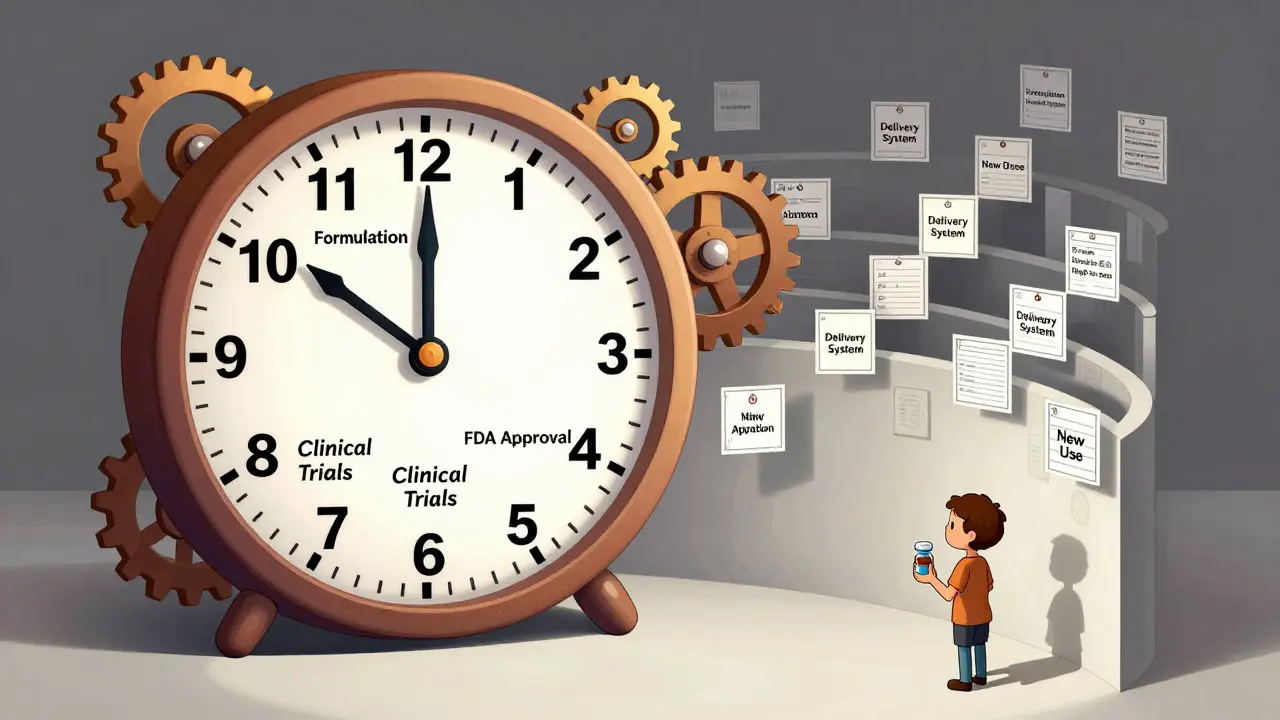
The 20-year patent term comes from international trade rules. Back in 1994, the U.S. changed its patent law to match global standards under the TRIPS Agreement. Before that, patents lasted 17 years from the date they were granted. Now, it’s 20 years from the day the application was first filed. Sounds simple, right? But here’s the catch: drugs take years to get approved.
A typical drug spends 5 to 10 years in clinical trials before the FDA even considers approving it. That means by the time a drug hits the market, half - or more - of the patent clock has already ticked away. For example, if a company files a patent in 2010 and gets FDA approval in 2018, they only have 12 years left of patent protection. But even that’s not the full story.
How the Patent Clock Gets Reset - or Extended
There are two big ways drug companies get extra time: Patent Term Adjustment (PTA) and Patent Term Extension (PTE).
PTA fixes delays caused by the U.S. Patent Office. If the patent office takes more than 14 months to issue the first review, or more than three years to grant the patent, they owe the company extra time. This isn’t automatic - it’s calculated based on who caused the delay. If the company took too long to respond to an examiner’s request, that time doesn’t count. In practice, PTA can add 1 to 5 years to a patent’s life.
PTE is even more important. Thanks to the Hatch-Waxman Act of 1984, companies can apply for up to five extra years of patent life to make up for time lost during FDA review. But there’s a hard cap: the total time a drug has market exclusivity - patent plus regulatory delays - can’t go beyond 14 years after FDA approval. And you’ve got to apply within 60 days of approval. Miss that window? You lose it forever.
Take Humira, the arthritis drug. Its main patent expired in 2023, but because of multiple extensions and layered patents, generic versions didn’t fully enter the market until 2024. That’s 14 years of exclusivity after approval - not 20 years from filing.
It’s Not Just One Patent - It’s a Whole Bundle
Big pharma doesn’t rely on one patent. They build a wall of them. A single drug can have dozens of patents covering:
- The active ingredient (the chemical that works)
- The way it’s made (manufacturing process)
- The form it comes in (tablet, injection, patch)
- How it’s used (treating a new condition)
Each of these has its own 20-year clock, starting from when it was filed. That means even if the original patent on the molecule expires, a newer patent on a delivery system or a new dosage might still be active.
Spinraza, a treatment for spinal muscular atrophy, is a textbook example. Its original patent expired in 2023, but other patents in its portfolio - covering formulations and methods of use - extend protection through 2030. This is called “evergreening.” Critics say it’s a way to delay generics. The FTC says it often pushes generic entry back by 2 to 3 years.

Regulatory Exclusivity - The Hidden Clock
Even without patents, the FDA can block generics. This is called regulatory exclusivity, and it runs parallel to patent time.
- New Chemical Entity (NCE) exclusivity: 5 years. No generic can even apply to the FDA during this time.
- Orphan Drug exclusivity: 7 years for drugs treating rare diseases (under 200,000 patients in the U.S.).
- New Clinical Investigation exclusivity: 3 years if the company did new studies for a new use or dosage.
- Pediatric exclusivity: 6 months added to any existing patent or exclusivity period if the company studies the drug in children.
These aren’t patents. They’re legal barriers built into the approval system. So even if a patent expires, a generic still can’t launch if one of these exclusivities is still running.
Take Eliquis, the blood thinner. Its main patent expired in December 2022. But because of pediatric exclusivity, generics couldn’t enter until June 2023 - six months later. And even then, it took months for them to hit shelves. By early 2024, generics had taken 35% of the market. Within a year, prices dropped 62%.
What Happens When the Patent Dies?
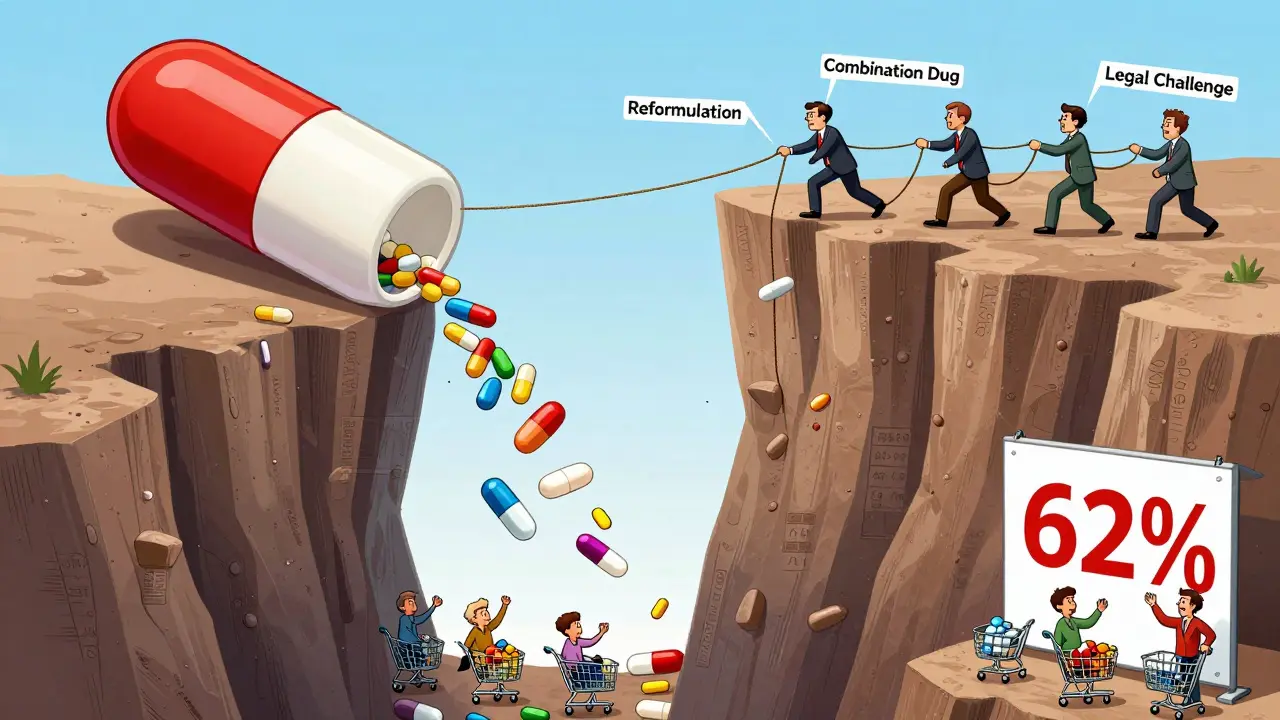
The moment a drug loses all protection - patent and exclusivity - it’s open season for generics. This is called the “patent cliff.”
Generic manufacturers don’t need to repeat expensive clinical trials. They just prove their version is the same as the brand. That’s why they can sell it for 80-95% less. For small-molecule drugs, generics usually capture 90% of the market within 18 months. For biologics - complex drugs made from living cells - it’s slower. Biosimilars take longer to develop and face more regulatory hurdles, so they often get only 40-60% market share.
The economic impact is huge. Evaluate Pharma estimates $62 billion in lost revenue for drugmakers in 2025 alone - the peak year of the current patent cliff. From 2023 to 2028, the industry will lose $268 billion total.
How Companies Try to Survive the Cliff
No company wants to lose billions overnight. So they plan years in advance.
- Reformulation: Change the pill to a once-daily version, or switch from pill to patch. That gets a new patent.
- Combination drugs: Bundle two drugs together. AstraZeneca’s Tagrisso combines osimertinib with other agents - its main patent expires in 2026, but the combo patent lasts until 2033.
- Companion diagnostics: Tie the drug to a test that only the brand can offer. That locks in doctors and patients.
- Legal challenges: Sue generic companies as soon as they file. Under Hatch-Waxman, this triggers a 30-month automatic delay in FDA approval.
About 78% of drugs facing patent expiration use at least one of these tactics, according to Bernstein Research.
How to Find Out When a Specific Drug’s Patent Expires
If you’re a patient, pharmacist, or investor, you need to know when a drug will go generic. The best source is the FDA’s Orange Book - a public database listing every approved drug and its patents.
You can search it for free. Look up the brand name, then check the patent numbers and expiration dates. But don’t stop there. Cross-check with regulatory exclusivity dates - those are listed separately.
Also, watch for patent litigation. If a generic company files a “Paragraph IV certification” challenging a patent, the brand may sue. That triggers a 30-month delay. The FTC says lawsuits take an average of 37 months to resolve - longer than the delay itself. That means even if a patent expires, generics might still be blocked for years.
What’s Changing Now?
The system is under pressure. The FTC and consumer groups say evergreening delays access and inflates prices. In 2024, Congress introduced the “Restoring the America Invents Act,” which could cut PTA by 6-9 months on average. The USPTO is also automating PTA calculations, with new rules rolling out in late 2024.
Meanwhile, the World Health Organization is pushing for global patent terms to drop from 20 to 15 years to improve access to medicines. The pharmaceutical industry, led by PhRMA, argues that 20 years is necessary to recoup the $2.3 billion average cost of developing a new drug.
But here’s the reality: most of that cost is spent on drugs that never make it to market. Only about 12% of drugs that enter clinical trials get approved. The 20-year clock doesn’t care about failure.
What This Means for You
If you’re a patient: Don’t assume your expensive drug will stay expensive forever. Check the Orange Book. Talk to your pharmacist. Ask if a generic is coming - and when. Some insurers switch you to generics as soon as they’re available. Others wait until the brand’s exclusivity runs out. Know your plan.
If you’re a caregiver: Watch for sudden price jumps. Sometimes, after pediatric exclusivity ends, insurers switch to a generic - but charge a higher copay because the generic isn’t yet preferred. That happened to one patient in 2023: her copay went from $50 to $200 after the 6-month pediatric extension ended, even though the brand was no longer under patent.
If you’re in healthcare or business: Understand that patent expiration isn’t a single date. It’s a series of overlapping timelines - legal, regulatory, commercial. Miss one, and you miss the window.
The system is complex, but it’s not magic. It’s rules. And if you know the rules, you can navigate them.
How long do drug patents really last?
The legal term is 20 years from the patent filing date, but most drugs only get 7-12 years of actual market exclusivity because clinical trials take 5-10 years. Extensions like Patent Term Extension (PTE) and regulatory exclusivity can push that to 14 years after FDA approval - but rarely longer.
Can a drug still be protected after its main patent expires?
Yes. Companies often file multiple patents covering different aspects of a drug - like delivery method, formulation, or new uses. These can expire years after the original patent. Even if the active ingredient is no longer protected, these secondary patents can block generics.
What is the Hatch-Waxman Act and why does it matter?
The Hatch-Waxman Act of 1984 created a balance: it lets generic companies enter the market faster by letting them skip costly clinical trials, but it also gives brand companies up to 5 extra years of patent life to make up for FDA review delays. It also lets brand companies sue generics and delay approval by 30 months - a key tool in protecting revenue.
How do I know when a specific drug will go generic?
Check the FDA’s Orange Book for patent expiration dates. Then cross-check with regulatory exclusivity periods - those are listed separately. Also, search for any pending lawsuits. A Paragraph IV certification and lawsuit can delay generic entry by up to 30 months, even after the patent expires.
Why are some generics so expensive right after launch?
Sometimes, the first generic to market gets 180 days of exclusivity - meaning no other generics can enter. During that time, the first generic can charge high prices. Also, insurance plans may not list the generic as preferred until after the exclusivity ends, leading to higher patient copays even when the drug is technically off-patent.
Is the 20-year patent system fair?
It’s designed to balance innovation and access. Drugmakers argue they need 20 years to recover $2.3 billion in R&D costs. Critics say most of that cost is spent on failed drugs, and that extensions and evergreening delay affordable access. The system works - but it’s complicated, and it often favors corporate strategy over patient affordability.


9 Responses
Let’s be real - the 20-year patent myth is corporate propaganda dressed up as law. The system’s rigged to let Big Pharma milk every last cent before generics even get a foot in the door. PTA? PTE? Regulatory exclusivity? It’s not innovation - it’s legal lockpicking. And don’t get me started on evergreening. You don’t invent a better drug, you just tweak the pill color and file another patent. The FDA’s basically a rubber stamp for pharma’s monopoly machine. This isn’t capitalism - it’s rent-seeking with a white coat.
Meanwhile, patients are paying $1,200/month for insulin while shareholders cash in. The math doesn’t add up - unless your goal is profit, not health.
Time to scrap Hatch-Waxman. Replace it with a 10-year cap from approval. No extensions. No loopholes. No more ‘patent thickets’ - just a clear, fair clock. If you spent $2.3B developing a drug? Congrats. Now go make the next one. The market doesn’t owe you a lifetime of exclusivity.
And yes, I’ve seen the Orange Book. I’ve checked the lawsuits. I’ve watched my neighbor’s copay jump from $30 to $200 because the ‘generic’ wasn’t ‘preferred’ yet. That’s not a market. That’s exploitation with a FDA seal.
I read this whole thing and just sat there thinking - how do regular people even navigate this? I’m not a lawyer, a pharmacist, or an investor. I just need my meds to not cost half my paycheck.
Is there a simple website that just tells you ‘this drug goes generic on X date’ without making you dig through 17 PDFs and lawsuit filings? I’d use it every month.
Also, why does the first generic cost more than the brand? That part still doesn’t make sense to me.
YESSSS this is so important!!! 🙌
My dad’s on Humira and we’ve been waiting for generics since 2020 - finally got them in 2024 and his copay dropped from $800 to $45. LIFE CHANGING.
But WHY did it take 14 years after approval?!? The system is broken and everyone knows it. Pharma’s playing chess while we’re playing checkers.
Also - check the Orange Book, people!!! It’s free!!! Stop asking your doctor to guess - go look it up yourself. It’s not magic, it’s just paperwork. 📚💪
And yeah, the 180-day exclusivity for the first generic? That’s a scam too. One company gets to be the ‘cheap’ option… for $500 a pill. 😒
Time to break the monopoly. #GenericRevolution
Who cares about patents when the real issue is that American healthcare is a joke? You think this is unique to the US? In India we get generics in months not years. Why? Because we don’t let corporations write our laws. You spend 20 years lobbying for extensions? That’s not innovation that’s corruption. Your system is designed to keep people sick so you can keep selling. The real patent is on greed.
And don’t even get me started on pediatric exclusivity - you study a drug on kids to get 6 extra months? That’s not science that’s extortion. We don’t need your 6 months. We need your ethics.
So you're telling me America lets drug companies stretch patents to 14 years after approval but we still have free healthcare for the rich? That's why your country is failing. In Nigeria we don't wait for patents to expire - we just make the medicine and ship it. No lawsuits no delays no corporate drama. You want cheap meds? Stop being so soft. Patent laws are for weak nations. Real countries don't ask permission to save lives.
Also why are you even talking about the Orange Book? Who has time for that? Just give us the pills
Okay so I just looked up Eliquis on the Orange Book and holy crap - there are like 12 patents listed and 3 of them expire in 2027?? And one’s for a ‘delivery system’?? WHAT IS THAT EVEN?? Like is it a new pill shape?? I thought patents were for the chemical?? Also why is there a 6-month pediatric extension?? Did they test it on babies?? And why does the first generic cost more than the brand?? I’m so confused now I think I’m gonna cry. Also typo: ‘exclusivity’ is spelled wrong in the article?? I’m not mad just disappointed. 🤦♀️
Let me tell you something - this whole system is a glitter-covered dumpster fire. 🌟🗑️
Big Pharma doesn’t sell drugs. They sell hope wrapped in patent paperwork. They don’t cure diseases - they monetize desperation. And you think your $200 insulin is expensive? Try being the person who has to choose between rent and refills. That’s not a choice - that’s a sentence.
Evergreening? More like ‘evergreedy’. Patent thickets? More like ‘patent traps’. The 180-day exclusivity for the first generic? That’s not a reward - it’s a bribe to keep prices high. And don’t even get me started on the 30-month litigation delay. It’s not a legal tool - it’s a delay tactic dressed in a robe.
Meanwhile, the WHO wants to shorten patent terms to 15 years. Good. But here’s the real fix: ban evergreening. Ban PTE. Ban pediatric extensions unless the drug is actually used in kids. And make the Orange Book searchable by ‘when will this be cheap?’
We don’t need more complexity. We need more courage.
And yes - your pharmacist knows more than your doctor about this. Talk to them. Ask. Demand. Don’t wait for Congress to fix it. Fix it yourself.
Look - I get it. Patents are supposed to incentivize innovation. But when 78% of drugs facing expiration use reformulation or combo tricks to extend monopoly? That’s not innovation - that’s legal gymnastics. The USPTO is basically a pharma puppet. PTA? PTE? Regulatory exclusivity? It’s all just delay theater.
And don’t get me started on biosimilars. Biologics are complex - yes - but why does it take 10 years to approve one? The EU does it in 3. Canada does it in 4. We’re lagging because we let lawsuits and bureaucracy strangle competition.
Meanwhile, the $268B in lost revenue by 2028? That’s not a crisis - that’s capitalism doing its job. The market corrected. The problem is we let the players rewrite the rules instead of enforcing them.
And the Orange Book? It’s a maze. No one outside of pharma lawyers can navigate it. That’s not transparency - that’s obfuscation.
Key takeaway: Patent expiration ≠ generic availability. Always check both patent AND regulatory exclusivity dates. The Orange Book is your friend. Cross-reference with FDA exclusivity listings. Watch for Paragraph IV filings - they trigger 30-month delays. And remember: the first generic isn’t always the cheapest. The 180-day exclusivity window lets them charge premium prices. Don’t assume ‘generic’ means ‘cheap’ - verify.
Also: pediatric exclusivity adds 6 months. It’s not optional. It’s automatic. And yes - it applies even if the drug was never studied in children. The law says so. It’s weird. But it’s real.