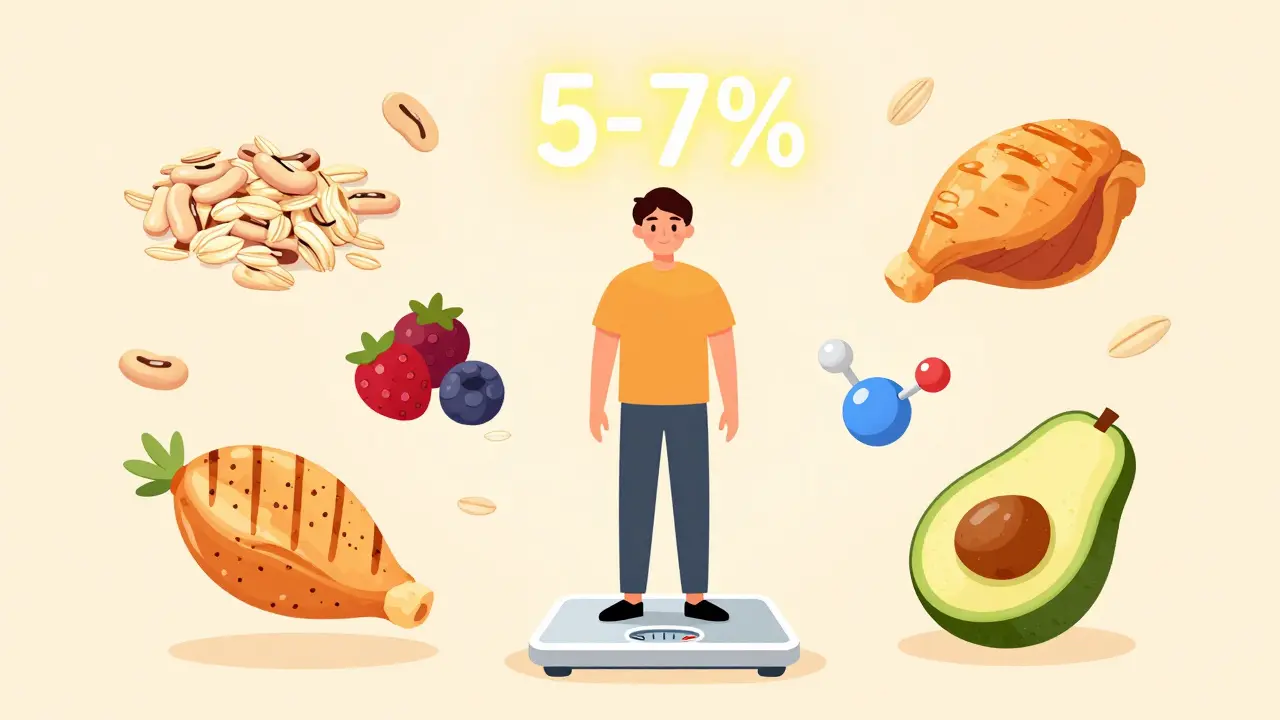
When you have type 2 diabetes, losing weight isn’t just about fitting into smaller clothes-it’s one of the most powerful ways to take back control of your health. Weight loss can lower your blood sugar, reduce the need for medication, and even reverse diabetes in some cases. But it’s not about crash diets or extreme restrictions. It’s about smart, sustainable changes that work with your body, not against it.
Extra weight, especially around the belly, makes your body less sensitive to insulin. That means your pancreas has to work harder to produce more insulin just to keep your blood sugar in check. Over time, that strain can wear out your insulin-producing cells. Losing even a small amount of weight-5% to 7% of your body weight-can dramatically improve how your body uses insulin.
Research from the Diabetes Prevention Program (DPP) showed that people with prediabetes who lost 5-7% of their body weight cut their risk of developing type 2 diabetes by 58%. That’s more effective than taking metformin. For those already diagnosed, studies like the DiRECT trial found that losing 10 kilograms (about 22 pounds) led to diabetes remission in nearly half of participants. This isn’t a fluke. It’s science. When you lose fat from your liver and pancreas, those organs start working better again.
You don’t need to lose 50 pounds to see big improvements. In fact, aiming for too much too fast can backfire. The sweet spot is 5-7% of your starting weight. For someone who weighs 200 pounds, that’s 10-14 pounds. For someone at 250 pounds, it’s 12-17.5 pounds.
That’s not just a number-it’s a game-changer. People who hit this target typically see:
And if you can lose 10% or more? That’s when remission becomes possible. The DiRECT trial showed that people who lost 10-15 kg had a 46% chance of reversing their diabetes after one year. The key? Keeping it off.
Not all weight loss plans are created equal when you have diabetes. Here’s what the evidence says actually works:
Creating a daily calorie deficit of 500-750 calories is the foundation. That means eating about 3,500 fewer calories per week to lose one pound. But it’s not just about cutting calories-it’s about what you cut.
Focus on:
Portion control matters more than you think. Use smaller plates. Measure servings for a few weeks. Learn what a 3-ounce serving of meat or half a cup of pasta looks like. You’ll be surprised how much you’ve been eating.
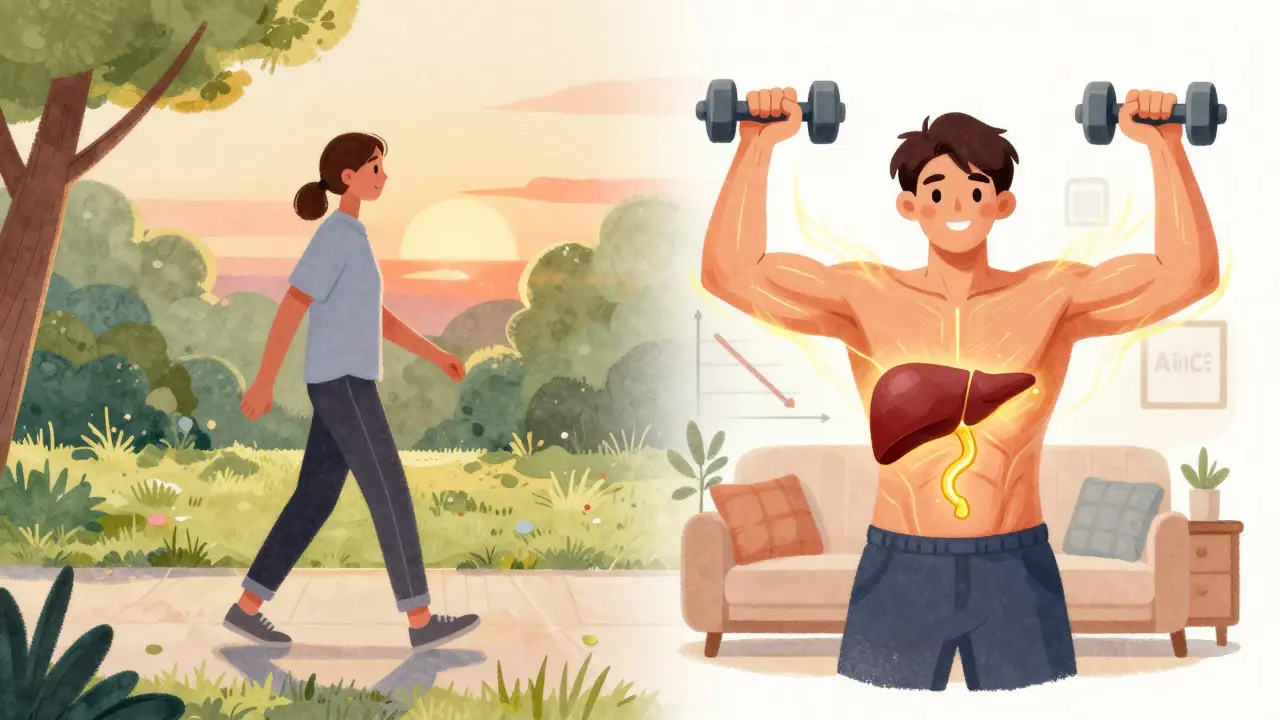
The CDC recommends 150 minutes of moderate activity per week. That’s 30 minutes, five days a week. Brisk walking counts. But if that’s all you do, you’re missing out.
Strength training is just as important. Do it twice a week. Lift weights, use resistance bands, or do bodyweight exercises like squats, push-ups, and lunges. Muscle burns more calories at rest than fat. More muscle = better insulin sensitivity.
And don’t overlook daily movement. Take the stairs. Park farther away. Stand while talking on the phone. These small things add up.
Tracking makes a difference. Apps like MyFitnessPal or the CDC’s Diabetes Prevention Program app help you log food, water, and activity. One Reddit user lost 18 pounds and broke through a plateau only after adding strength training and tracking meals consistently.
Continuous glucose monitors (CGMs) are no longer just for insulin users. Seeing how your blood sugar reacts to different foods gives you real-time feedback. You’ll learn which foods spike you and which ones keep you steady.
Not every diet is safe or effective for people with diabetes.
On the American Diabetes Association’s community forum, one user shared: “I lost 22 pounds in six months. I walked 150 minutes a week and started measuring my portions. My A1C dropped from 7.2% to 5.9%.”
Another user on Reddit said: “I hit a wall at 3 months. Then I started lifting weights twice a week. The scale moved again.”
But it’s not all smooth sailing. Some people struggle with emotional eating. A 2023 survey found 42% of people with diabetes cited stress or emotions as their biggest barrier. That’s why support matters. Join a group. Find a buddy. Talk to a certified diabetes educator.
Your meds can help or hurt your weight loss efforts.
A 2021 study in the New England Journal of Medicine found semaglutide users lost nearly 15% of their body weight over 68 weeks. That’s not magic. It’s science. But these drugs aren’t for everyone. Side effects like nausea and diarrhea can be tough. And they’re expensive.
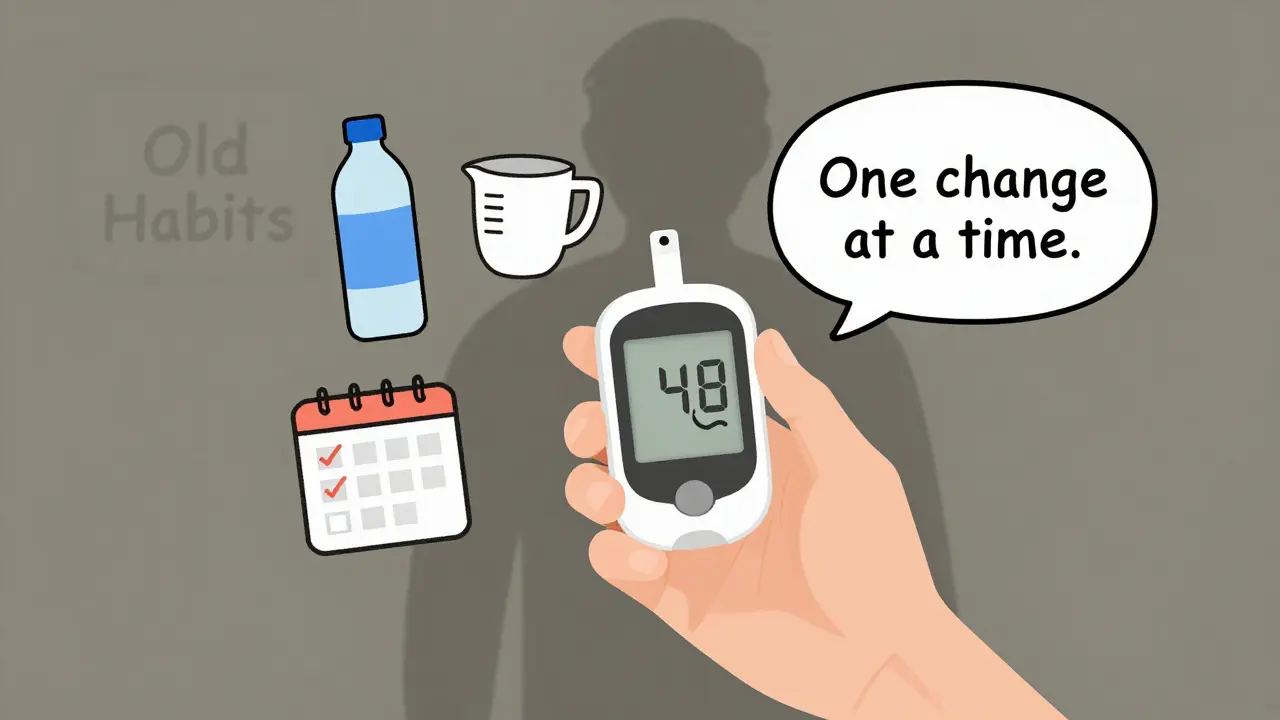
Most people lose weight fine-then gain it back. Why? Because they stop the habits that got them there.
Here’s how to make it stick:
You don’t need to be perfect. You just need to be consistent. Losing 10 pounds might not sound like much-but it can mean the difference between managing diabetes and reversing it. The goal isn’t to be thin. It’s to be healthier. Stronger. More in control.
Start with one change. Drink more water. Take a 10-minute walk after dinner. Swap soda for sparkling water. Build from there. Progress, not perfection.
Yes, in many cases. Studies like the DiRECT trial show that losing 10-15 kg (22-33 lbs) can lead to diabetes remission in nearly half of participants. This happens because weight loss reduces fat in the liver and pancreas, allowing these organs to function normally again. Remission means blood sugar stays in the normal range without medication. It’s not a cure, but it’s a major win.
Even 5-7% of your body weight can make a big difference. For someone weighing 200 pounds, that’s 10-14 pounds. This small loss improves insulin sensitivity, lowers A1C, and reduces the need for medication. Losing 10% or more increases the chance of diabetes remission.
Yes-but you must work with your healthcare team. Losing weight can increase your risk of low blood sugar (hypoglycemia) if you’re on insulin or sulfonylureas. Your doctor may need to lower your dose before or as you lose weight. Never adjust insulin on your own. Regular monitoring and communication are key.
There’s no single “best” diet, but the most effective approaches focus on whole foods, high fiber, lean protein, and healthy fats. The Mediterranean diet and DPP-style eating plans have the strongest evidence. Avoid ultra-processed foods, sugary drinks, and refined carbs. Portion control is just as important as what you eat.
You can lose weight with diet alone-but exercise makes it easier and keeps the weight off. Physical activity improves insulin sensitivity, helps preserve muscle mass, and boosts mood. Aim for 150 minutes of walking or similar activity per week, plus two strength training sessions. Even small movements like standing more or taking the stairs help.


13 Responses
Just dropped 18 lbs in 5 months and my A1C went from 7.1 to 5.8 🎉
Turned out the magic wasn’t some crazy diet - just measuring my rice, walking after dinner, and swapping soda for sparkling water with lime. Seriously, start small. No need to overhaul your whole life.
Also, CGM was a game-changer. Saw how my “healthy” granola bar spiked me like a rocket. Now I eat almonds instead. Boom. Stable sugars. 😎
Wow... so losing 10 pounds is gonna reverse diabetes??
My cat lost 10 pounds last year... and she’s still a cat.
Also, I’ve been told I’m ‘pre-diabetic’... so I’m just gonna wait for the robot doctors to fix me. 😌
While I appreciate the well-researched nature of this article, I must point out that the DiRECT trial's sample size was relatively small and lacked long-term follow-up beyond two years. Furthermore, the term 'reversal' is scientifically misleading - remission is the accurate terminology, as beta-cell function may deteriorate again under metabolic stress.
Additionally, the suggestion that 5–7% weight loss universally improves insulin sensitivity ignores significant heterogeneity in adipose tissue distribution and genetic predisposition. One size does not fit all - particularly in populations with higher visceral adiposity or lipodystrophy.
bro i was eatin’ burritos like they were gonna stop makin’ ‘em
then i started doin’ 10 min of squats after every meal and swapped the tortilla for romaine leaves
lost 22 lbs in 4 months, my doc was like ‘dude did you do a podcast or somethin’?’
turns out, it’s not about willpower - it’s about not lettin’ your hunger decide for you
also, i still eat burritos. just… less carbs. more guac. 🥑
This is so empowering!! 🙌
I started with just drinking water instead of juice - and now I’m doing 3x weekly strength training and tracking my meals on MyFitnessPal.
My A1C dropped 1.2% in 5 months, and I finally feel like I’m not fighting my body - I’m working with it.
To anyone feeling stuck: you don’t need to be perfect. Just show up. One meal. One walk. One day at a time. You got this!! 💪❤️
They say losing weight reverses diabetes
But what they don’t tell you is Big Pharma already has a drug for that
Semaglutide costs $1k/month
And your ‘lifestyle changes’ just make you more dependent on their next pill
They want you to think you’re in control
You’re not
You’re just the next customer
meh. i tried this. lost 3 lbs. gave up. now i eat cake. life’s too short.
Okay, so the guy who said he hit a plateau and then started lifting weights? That’s the real MVP.
Most people think cardio is the answer - nah. Muscle is the secret sauce. It’s your body’s metabolic furnace.
Also - if you’re not lifting at least twice a week, you’re basically just dieting to get skinny… not to get healthy.
Try it. You’ll feel stronger. Your blood sugar will thank you. And your future self will high-five you.
I’ve been a nurse for 22 years. I’ve seen hundreds of patients try to lose weight with diabetes.
The ones who succeed? They didn’t do anything flashy. They just showed up. Every day. A walk. A vegetable. A sleep. A check-in with their doctor.
It’s not about willpower. It’s about routine.
And yes - even 5% weight loss changes everything.
Don’t underestimate the power of consistency. It’s quiet. It’s boring. But it works.
It’s interesting how the language of ‘reversal’ persists despite the scientific consensus preferring ‘remission’ - a subtle but crucial distinction
Remission implies a suspended state, not eradication
And yet, the emotional weight of the word ‘reversal’ may motivate adherence more effectively
Perhaps we need both: precision in science and poetry in communication
THEY SAID I COULDN’T DO IT
THEY SAID I WAS TOO OLD
THEY SAID MY PANCREAS WAS DEAD
I LOST 37 POUNDS IN 8 MONTHS
MY A1C IS NOW 5.1
THEY’RE ALL SILENT NOW
THEY’RE ALL SILENT
THEY’RE ALL SILENT
From a clinical endocrinology perspective, the adipose tissue redistribution hypothesis - specifically, the reduction of ectopic lipid deposition in the liver and pancreas - underpins the mechanism of remission
However, inter-individual variability in beta-cell reserve and insulin resistance dynamics necessitates personalized thresholds
Moreover, the efficacy of GLP-1 RAs appears synergistic with lifestyle modification, suggesting a multimodal paradigm is optimal
Future studies should stratify by genetic markers (e.g., TCF7L2 variants) to refine predictive models
Every journey begins with one step.
Not a grand plan. Not a 100-page diet. Just one small, brave choice.
Drink water today.
Walk after dinner.
Choose vegetables over fries.
That’s all it takes to begin.
You don’t need to be perfect.
You just need to begin.
And you’re already on your way.