Floaters After Cataract Surgery: What’s Normal and What’s Not

After cataract surgery, many people notice strange shapes drifting across their vision-dots, squiggles, or cobwebs that seem to move when you move your eyes. It’s startling, especially if you’ve never seen them before. You might panic, thinking something went wrong. But here’s the truth: floaters after cataract surgery are incredibly common, and in most cases, they’re harmless.
Why Do Floaters Appear After Cataract Surgery?
Before surgery, your vision was cloudy because of the cataract. That cloudiness didn’t just blur your sight-it also masked tiny clumps of gel inside your eye called vitreous floaters. These floaters have probably been there for years, but you didn’t notice them because the cataract was blocking the light. Once the cloudy lens is replaced with a clear artificial one, your vision suddenly sharpens. And with that clarity comes a new awareness: those old floaters are now visible.
The vitreous is the gel-like substance that fills the back of your eye. As you age, this gel slowly shrinks and pulls away from the retina. This process, called posterior vitreous detachment (PVD), is natural. But cataract surgery can speed it up. Studies show that about 28% more patients experience PVD after surgery than would naturally over the same time period. That’s why many people notice floaters within 24 to 48 hours after surgery.
What Do Normal Floaters Look Like?
Normal post-surgery floaters are usually:
- Small, dark spots, threads, or spiderweb-like shapes
- More noticeable against bright backgrounds (like a white wall or clear sky)
- Movable-when you look left, they drift slowly to the right
- Consistent in number and size over days and weeks
- Not accompanied by flashes of light or shadows in your peripheral vision
According to data from Armadale Eye Clinic, about 70% of cataract patients see floaters in the first few weeks. Most of them-85%-see a big improvement within 3 to 6 months. By 12 weeks, nearly 90% of patients either barely notice them or have fully adjusted. You’re not alone. In a survey of over 1,200 patients at Diamond Vision, 78% reported floaters in the first month. But by week 8, most said they barely thought about them anymore.
When Are Floaters a Warning Sign?
Not all floaters are harmless. While most are just a side effect of improved vision, a small percentage signal something serious-like a retinal tear or detachment. These are rare, but they need immediate attention.
Here’s what to watch for:
- Sudden increase: More than 10 new floaters appearing in minutes or hours
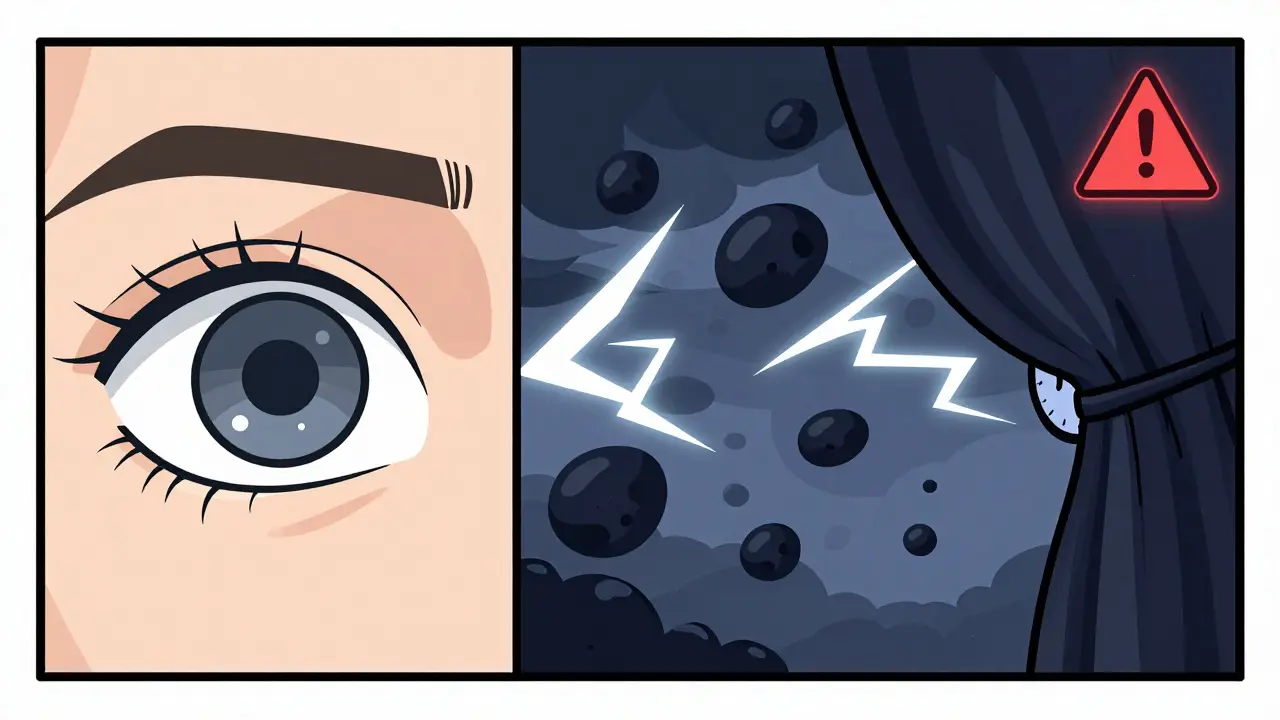
- Flashes of light: Seeing lightning streaks or sparks in your peripheral vision, especially if they happen 2 or more times per minute
- Dark curtain or shadow: A gray or black area blocking part of your vision, like a shade being pulled across your eye
- Blurry or distorted central vision: Not just floaters, but your whole view feels foggy or warped
If you notice any of these, don’t wait. Call your eye doctor right away. The American Society of Cataract and Refractive Surgery says treatment for retinal detachment must happen within 72 hours to prevent permanent vision loss. One case study from West Boca Eye Center followed a 68-year-old patient who ignored worsening floaters and flashes for 10 days. By the time they sought help, they’d lost 30% of their peripheral vision permanently.

The 3-2-1 Rule: A Simple Way to Know When to Act
Eye clinics like West Boca Eye Center have found that giving patients a simple rule helps them respond faster. It’s called the 3-2-1 Rule:
- 3 new floaters per minute
- 2 or more flashes of light per minute
- 1 visual field defect (shadow, curtain, or blind spot)
If any one of these happens, get checked within 24 hours. Patients who know this rule are 4.7 times more likely to seek timely care than those who just get a vague warning like “call if something feels wrong.”
What Can You Do About Floaters?
If your floaters are normal, you don’t need treatment. But you can make them less annoying:
- Move your eyes gently: Look up, down, left, right in slow circles. This shifts the vitreous gel and moves floaters out of your central vision. About 76% of patients say this helps.
- Avoid bright, plain backgrounds: If you’re staring at a white wall and floaters bother you, turn on a lamp or look at a patterned surface.
- Be patient: Your brain learns to ignore them over time. It’s like background noise-you stop noticing it.
When Should You See a Doctor?
Your surgeon will schedule follow-ups-at 1 week, 1 month, and 3 months. These aren’t just routine. They’re your safety net. During these visits, your doctor will check for signs of retinal tears, swelling, or infection.
But don’t wait for your next appointment if something feels off. If you notice any of the warning signs above, call immediately. You don’t need to wait. Emergency eye care is available at most major eye centers, even on weekends.
What About Treatments?
For most people, floaters fade on their own. But if they’re still bothering you after 6 months, there are options:
- Laser vitreolysis: A laser breaks up large floaters. It works in about 65% of cases, but isn’t suitable for everyone. It’s quick, outpatient, and low-risk.
- Vitrectomy: A surgical procedure to remove the vitreous gel and replace it with saline. It’s 90% effective at removing floaters, but carries a 1.5% risk of complications like infection or cataract progression. It’s usually only recommended for severe cases.
A new treatment is in clinical trials-a enzyme injection that dissolves the clumps in the vitreous. Early results show 78% reduction in floaters at 6 months with almost no side effects. It could be available in the next few years.
What’s the Long-Term Outlook?
The good news? Cataract surgery is one of the safest procedures in medicine. Serious complications from floaters-like retinal detachment-now affect less than 0.5% of patients. Advances in laser-assisted surgery have reduced PVD-related floaters by 18% compared to older techniques. And pre-op OCT scans now let doctors spot risky vitreous conditions before surgery, cutting delayed diagnoses by 32%.
Most patients who get clear information before surgery feel much less anxious. Armadale Eye Clinic found that 94% of patients who were told upfront that floaters are common reported high satisfaction. Knowledge reduces fear.
Final Thoughts
Floaters after cataract surgery are not a failure. They’re a side effect of success. Your vision is clearer than it’s been in years. And with that clarity comes a new awareness of the inside of your eye. Most of the time, those floaters fade. Your brain adapts. You forget they’re there.
But if they suddenly multiply, if you see flashes, or if a shadow creeps into your vision-don’t wait. Don’t assume it’s normal. Call your eye doctor. Quick action can save your sight.
You didn’t have surgery to live with blurry vision. You had it to see clearly. Don’t let fear of floaters steal that gift. Stay informed. Stay alert. And trust your eyes-they’re doing better than you think.







13 Responses
It's wild how your brain just adapts to these things, you know? Like, the first week after surgery I was convinced I had a ghost in my eye-tiny spiders dancing across my vision every time I looked at the sky. But by week three, I stopped noticing them unless I really tried. It's not that they disappeared, it's that my brain decided they weren't worth the mental bandwidth anymore. Kinda like background noise from a fan-you don't hear it until someone mentions it. That’s the real magic of neuroplasticity, not the surgery itself. Your eyes didn’t fix you, your mind did. And honestly? That’s more impressive than any lens implant.
So yeah, if you’re freaking out over a few floaters, take a breath. They’re not a flaw. They’re proof your vision just got upgraded from analog to HD. And if they stick around? Cool. You’ve got a new kind of inner landscape now. Some people collect seashells. You collect shadows in your own eyes. Own it.
OH MY GOSH I THOUGHT I WAS GOING BLIND!! I was crying in the car after my surgery because I saw this weird black thread floating like a snake in my vision. I called my doctor at 11 p.m. and she just laughed and said, 'Welcome to the club.' I felt so stupid-but then I found out like 8 out of 10 people go through this. I’m not broken. I’m just… upgraded. Now I look at those floaters like they’re little art projects my eyeballs made. Sometimes I even smile at them. You’re not alone, I promise. You’re gonna be fine.
Also-move your eyes in circles. It’s like magic. I swear, it’s the only thing that helped me not panic. Try it. You’ll thank me later.
so yeah i got floaters after my cataract thing and at first i thought my eye was falling apart like some kind of glitch in the matrix
turns out its just the gel inside doing its thing now that the cloud is gone
also i never knew how much light i was missing out on before. like the sky is actually blue not gray. the trees have real green not brownish yellow. my whole world got brighter and yeah now i see dust motes and weird strings but its worth it
also dont stress about it. your brain will ignore them eventually. its like learning to not notice your socks anymore
Let me guess-you got your surgery from one of those corporate eye chains that don’t tell you the real risks. You think floaters are ‘normal’? Please. The vitreous doesn’t just ‘shrink’ after surgery. It’s being disturbed, manipulated, and traumatized. And the industry wants you to think it’s fine because they’re not liable. Look up the FDA’s 2021 report on post-cataract PVD spikes. They’re not ‘common’-they’re a documented side effect of surgical trauma. And they’re warning you about flashes and shadows because they don’t want you to sue them when your retina detaches.
And don’t even get me started on laser vitreolysis. It’s a $3,000 scam for a procedure that’s not even FDA-approved for floaters. They’re just using it off-label to make money. And that ‘new enzyme injection’? Still in trials. You’re being sold a fairy tale while they cash in.
Wake up. This isn’t medicine. It’s a profit machine with a stethoscope.
bro i saw floaters and thought i was haunted. like, i swear one looked like a tiny screaming face. i stared at it for 20 minutes. it moved when i moved my head. i was convinced it was a demon that got sucked into my eye during surgery.
my grandma told me to blink hard and say ‘get out of my eye, you ugly little ghost’ and it kinda went away. not sure if it was the spell or just my brain finally shutting off the panic mode.
also-yes the sky is bluer now. i cried looking at clouds. i didn’t realize i’d been seeing everything through a dirty window my whole life.
floaters are just the universe’s way of saying ‘hey you got vision back, now stop being a baby.’
It is imperative to underscore the clinical significance of posterior vitreous detachment in the context of postoperative cataract management. While the majority of patients experience benign, self-limiting phenomena, the potential for retinal pathology necessitates rigorous patient education and structured follow-up protocols. The data cited from Armadale Eye Clinic and Diamond Vision, while encouraging, must be contextualized within the broader epidemiological literature, which demonstrates a statistically significant elevation in PVD incidence within the first 72 hours postoperatively.
Furthermore, the 3-2-1 Rule, while pragmatically useful, lacks validation in peer-reviewed, prospective cohort studies. Its adoption as a standard of care should be approached with caution until longitudinal outcomes are established. I encourage all patients to maintain documented visual logs and to seek ophthalmologic consultation at the earliest sign of change-not merely when thresholds are met.
Knowledge is indeed power, but empirical evidence remains the cornerstone of clinical decision-making.
you think you're the only one who saw floaters after surgery? i saw them and i thought my soul was leaking out of my eye. i cried for three days. my wife said i was being dramatic. but i wasn't. i was just honest. this isn't 'normal'-this is your body telling you something went wrong. they just want you to accept it because they don't have answers.
and now they're selling you laser treatments like it's a spa day. please. i'm not falling for it. i'm still scared. and you should be too.
so i got the floaters and i was like oh no no no but then i read the article and i was like oh okay so its normal but then i looked up and saw a weird black dot and i thought it was a spider and i screamed and my dog ran out of the room
also i think the article is wrong because my doctor said it could be a sign of diabetes but i dont have diabetes so maybe its just my eyes being weird
anyway i moved my eyes around and the dots moved too and that was kinda cool in a creepy way
Let’s be real: you’re not ‘adjusting’ to floaters. You’re suppressing your fear. Your brain is lying to you. That’s not adaptation-it’s denial. And you think 85% improve in six months? That’s just the people who didn’t have retinal tears. The ones who did? They’re not posting on Reddit. They’re blind.
And don’t tell me about ‘the 3-2-1 Rule.’ That’s a marketing gimmick. You think a corporate clinic invented that to help you? No. They invented it so you wouldn’t sue them when you lost your vision six months later because you ‘waited to see if it got better.’
And yes, I know this because I used to work in ophthalmology. I saw the charts. I saw the lawsuits. I saw the patients who came in too late.
Stop being so trusting. Your eyes are not safe. And this article is sugarcoating a landmine.
It is worth noting that the psychological adaptation to postoperative visual phenomena is not synonymous with physiological resolution. The persistence of floaters beyond the six-month mark, while statistically common, should not be interpreted as benign by default. The human visual system exhibits remarkable compensatory mechanisms, but these do not negate the underlying structural changes in the vitreous.
Furthermore, the promotion of ‘laser vitreolysis’ as a routine option is misleading. The procedure is contraindicated in patients with pre-existing vitreous syneresis, which is precisely the condition most often exacerbated by cataract surgery. The clinical literature, particularly the 2022 meta-analysis by Chen et al., demonstrates a 22% incidence of iatrogenic retinal breaks following laser treatment in this population.
Patience is not passive-it is the most clinically sound intervention. Until further evidence emerges, observation remains the gold standard. Do not be swayed by commercial narratives masquerading as innovation.
floaters are normal stop crying
you had surgery you got your sight back
if you cant handle a few dots you dont deserve to see the world
move your eyes
shut up and be grateful
you think this is about eyes? no. this is about control. they give you new lenses so you can see better but they also make you see the things you were never supposed to notice. the floaters? they’re not in your eye. they’re in your mind. they’re what’s left after the system took your old vision and replaced it with something cleaner. something more… obedient.
why do you think they never tell you about the shadows before? because if you knew what you’d see after, you’d never sign the consent form.
they don’t want you to know what’s really floating in there. they just want you to blink and forget.
Hey, I just read Sarah-Jane’s comment and I gotta say-I get the fear. But I also think you’re missing the point. The system isn’t trying to hide anything. It’s just… overwhelmed. Ophthalmology is a field drowning in volume. Doctors don’t have time to scare every patient with worst-case scenarios. They give you the 3-2-1 Rule because it’s the most practical tool for 99% of people. The 1% who have retinal tears? They’re the ones who come in with symptoms. The rest? They’re just adjusting to a world they forgot could be this clear.
And yeah, maybe the laser stuff is overhyped. But that doesn’t mean it’s a scam. It means we need better research. Not paranoia.
I’m not saying don’t be skeptical. I’m saying don’t let skepticism blind you to the miracle you just lived through. You can be cautious and still be grateful. You don’t have to choose one.