Generic Pill Appearance Changes: What You Need to Know About Safety, Legality, and Patient Adherence
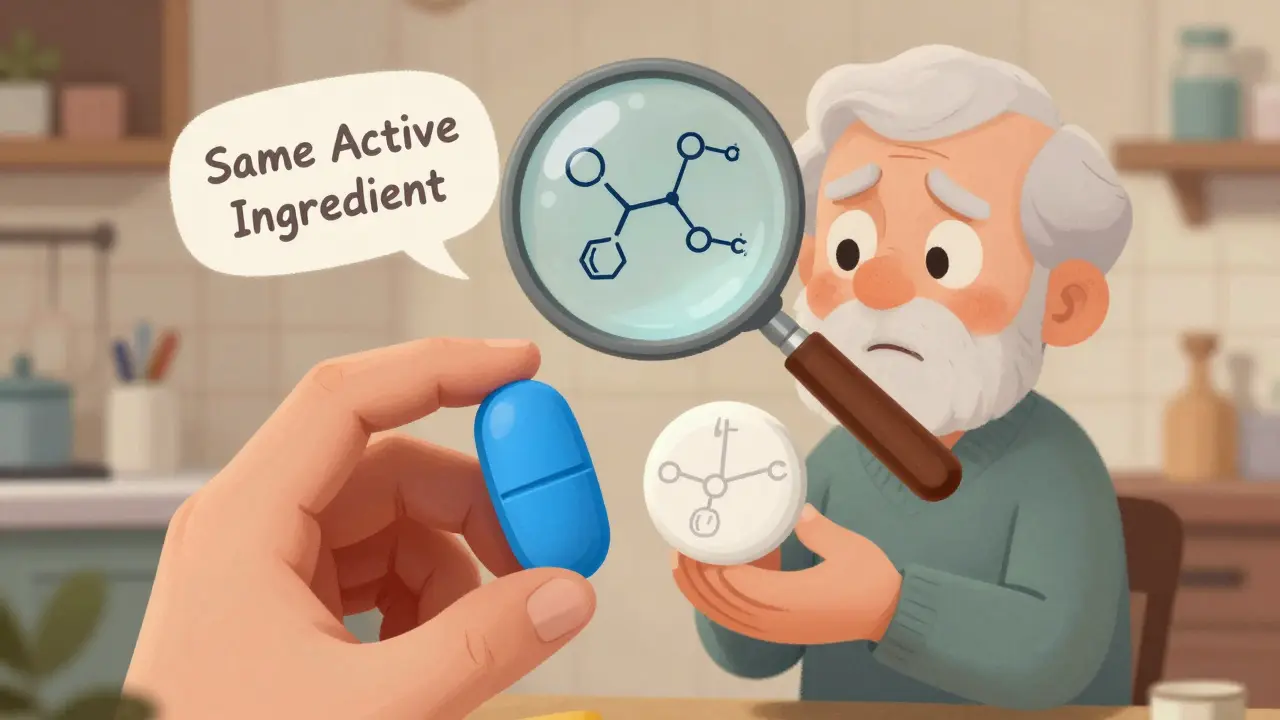
Ever opened your pill bottle and thought, "This isn’t the same pill I’ve been taking for years"? You’re not alone. Millions of people in the U.S. face this exact moment every year. Generic medications are supposed to be the same as brand-name drugs - same active ingredient, same strength, same effect. But they often look completely different. A blue pill becomes white. A round tablet turns oval. Sometimes, even the markings on the pill change. These shifts aren’t mistakes. They’re legal. And they’re happening more often than most patients realize.
Why Do Generic Pills Look Different?
The reason is simple: trademark law. In the U.S., generic drug makers are not allowed to make their pills look exactly like the brand-name version. This rule, enforced by the FDA, exists so patients and pharmacists can tell the difference between brands and generics. But it also means every manufacturer picks its own color, shape, and size. One company’s sertraline might be a blue oval. Another’s could be a white circle. Both contain the exact same active ingredient. Both work the same way. But they don’t look the same.
This isn’t just about branding. It’s about competition. There are dozens of companies making generic versions of common drugs like metformin, lisinopril, and gabapentin. Each one wants to stand out. So they choose different appearances. And because pharmacies often switch to the cheapest option available, your pill can change every time you refill - even if your prescription hasn’t changed.
Is It Safe?
Yes. The FDA requires every generic drug to prove it’s bioequivalent to the brand-name version. That means it must deliver the same amount of active ingredient into your bloodstream at the same rate. It must meet the same strict standards for purity, strength, and stability. The FDA inspects manufacturing facilities just like it does for brand-name drugs. So if your pill looks different, but your doctor prescribed it, it’s still safe.
The inactive ingredients - the fillers, dyes, and coatings - can vary. That’s why some people notice slight differences in how a pill tastes or how quickly it dissolves. But these don’t affect how well the medicine works. For the vast majority of patients, appearance changes have no impact on safety.
The real danger isn’t the pill itself. It’s what happens when you stop taking it because you think it’s wrong.
The Real Risk: Patient Confusion and Non-Adherence
A study in the
Annals of Internal Medicine found that 34% of patients stopped taking their medication after a color change. That number jumped to 66% when the shape changed. These aren’t small numbers. These are people with high blood pressure, diabetes, depression - conditions that require daily medication to stay stable.
One patient in Los Angeles reported her potassium pills changed nine times over 15 years. She recognized them by their bright orange color and flat, circular shape. When they turned white and capsule-shaped, she thought she’d been given the wrong medicine. She stopped taking them for two weeks. Her potassium levels dropped. She ended up in the ER.
Another man on blood pressure medication saw his pills go from white to pink. He thought the pharmacy made a mistake. He didn’t refill. His blood pressure spiked. He had a minor stroke.
These aren’t rare cases. A 2022 survey by the American Pharmacists Association found that 42% of patients had at least one appearance change in their regular meds over 12 months. Nearly 30% said they were worried enough to consider stopping the drug.
People associate colors with effectiveness. Blue = strong. Pink = gentle. White = safe. When those associations break, trust breaks too. And when trust breaks, adherence drops.
Legality: What the Law Actually Says
The FDA doesn’t require generic drugs to match brand-name pills in appearance. That’s not a loophole. It’s written into the law. The Hatch-Waxman Act of 1984 created the modern generic drug system. It allowed cheaper versions to enter the market - but with one condition: they couldn’t copy the brand’s look. This was meant to prevent consumer confusion and protect trademark rights.
Today, over 70% of all prescriptions filled in the U.S. are for generic drugs. That’s more than 4 billion prescriptions a year. And in most cases, multiple manufacturers make the same generic. So if your pharmacy switches suppliers - which they often do to save money - your pill changes.
The FDA does regulate how much variation is allowed in manufacturing. Pills must be within strict size and weight tolerances. But color? Shape? Markings? Those are up to the company. And they’re allowed to change them without notifying the FDA - as long as the active ingredient stays the same.
What You Can Do to Stay Safe
You don’t have to guess. You don’t have to panic. Here’s what actually works:
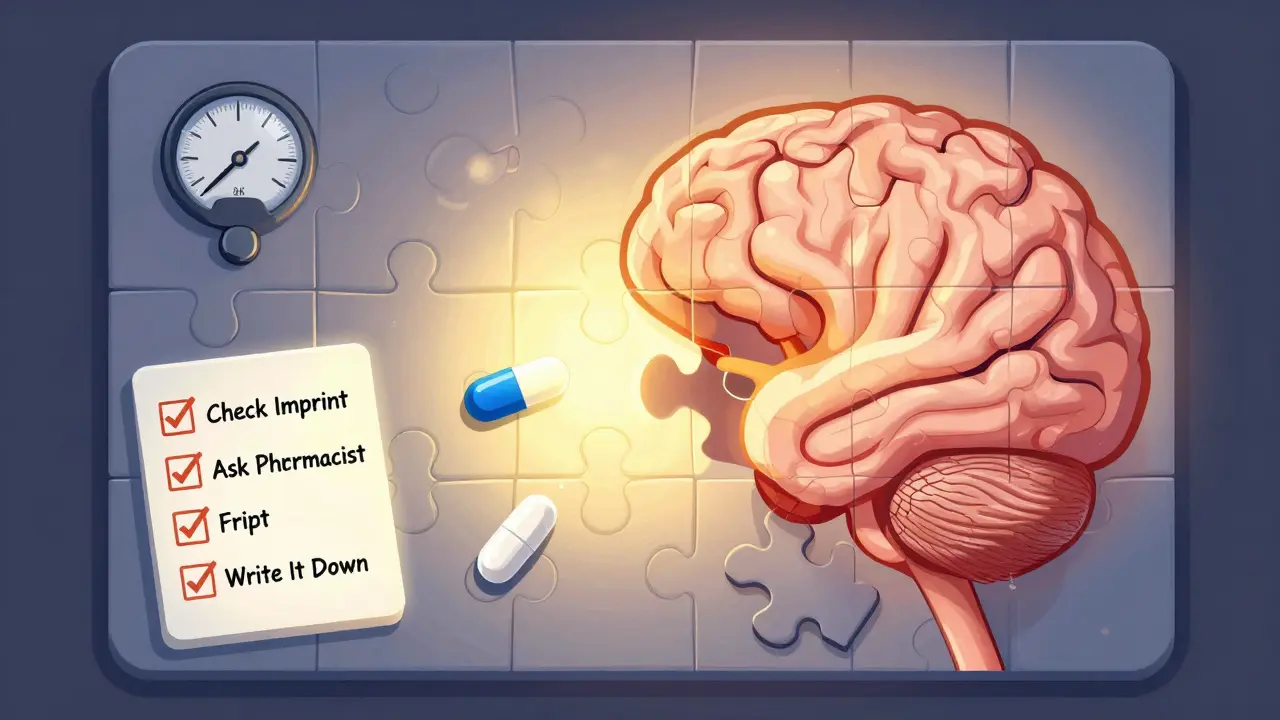
- Keep a written list of every medication you take - including the pill’s shape, color, and marking. Write it down when you get it. Update it when it changes. Bring this list to every doctor visit.
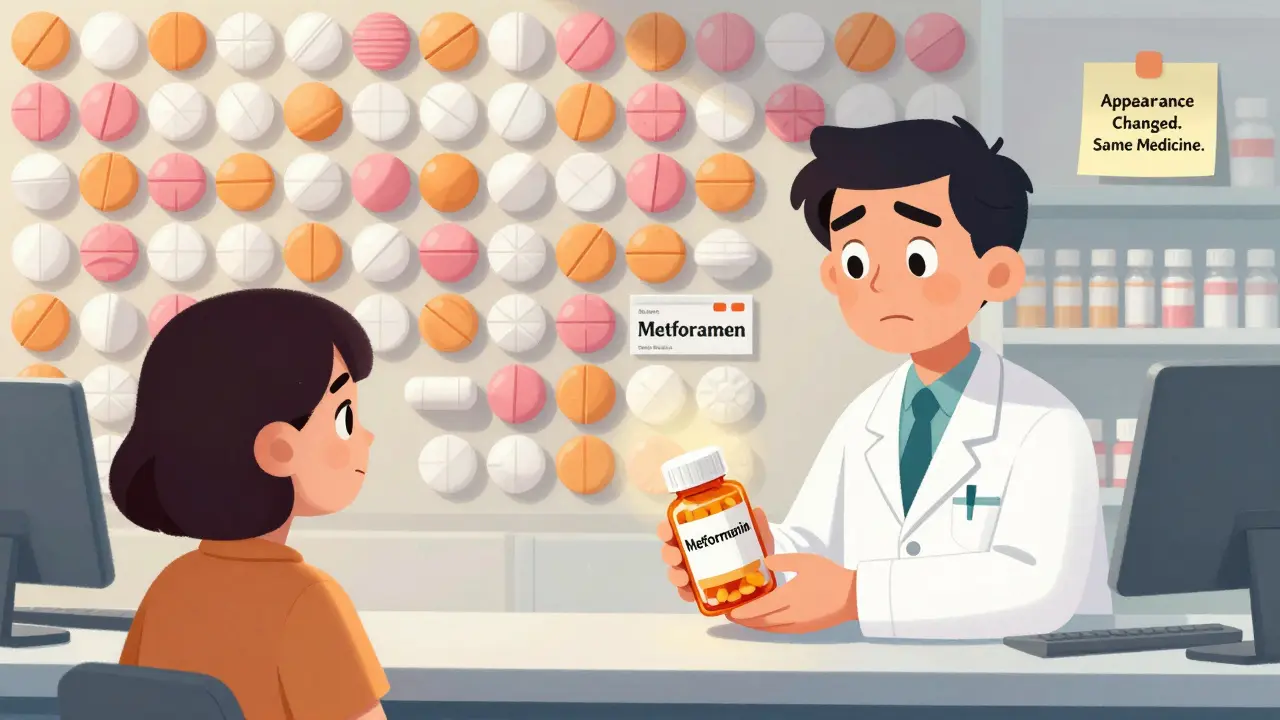
- Ask your pharmacist every time you pick up a refill. Say: “Is this the same medicine I got last time?” They’re trained to explain changes. Most pharmacies now include appearance change notes on the label.
- Use a pill identifier tool. Websites like Medscape’s Pill Identifier let you search by color, shape, and imprint. You can take a photo of your pill and match it to the correct drug.
- Don’t stop taking it just because it looks different. If you’re unsure, call your pharmacist or doctor. Don’t wait.
- Ask about consistency. Some pharmacies can order from the same manufacturer each time. It might cost a little more, but it avoids confusion.
What Pharmacists and Doctors Are Doing
The healthcare system is waking up to this problem. In 2018, only 45% of pharmacies notified patients about appearance changes. By 2023, that number jumped to 78%. Many now print a small note on the prescription label:
“This medication has changed appearance. Active ingredient unchanged.”
Independent pharmacies are setting up pill identification stations. Some even keep sample pills on hand so patients can compare. The National Community Pharmacists Association reports that 63% of independent pharmacies now have these programs - up from 32% in 2020.
Doctors are also changing how they talk about generics. Instead of saying,
“You’re on a generic now,” they’re saying,
“Your medication might look different, but it’s the same medicine.” They’re teaching patients to look at the imprint - the letters or numbers stamped on the pill - not the color.
What’s Next?
Experts have been calling for change for years. In a 2014 letter to the
ACP Journal, Drs. Uhl and Peters wrote that bioequivalent generics that look like their brand-name counterparts
“enhance patient acceptance.” They’re not wrong.
The FDA has acknowledged the problem. The MODERN Labeling Act of 2020 gave the agency more power to update generic drug labels quickly when new safety data emerges. And in September 2025, the FDA announced new rules under Section 505(o)(4) of the Federal Food, Drug, and Cosmetic Act - allowing it to require labeling changes based on new safety information, including adherence risks.
But the biggest barrier isn’t regulation. It’s trademark law. As long as companies can’t make generics look like brand-name pills, appearance changes will keep happening. Some countries - like Canada and the UK - allow generics to match brand-name appearance. Patient adherence is higher there.
The U.S. may eventually move toward more standardization. But until then, the responsibility falls on you.
Final Advice: Don’t Assume. Verify.
Your medication is not your enemy. The system is. But you have more control than you think. If you take daily pills - for blood pressure, thyroid, depression, or diabetes - treat appearance changes like a red flag. Not because the pill is wrong. But because your brain might think it is.
Write it down. Ask the pharmacist. Check the imprint. Don’t guess. Don’t stop. And if you’re ever unsure - call your doctor. It’s better to spend five minutes on the phone than risk your health because a pill changed color.
Is it safe to take a generic pill that looks different from my last refill?
Yes. Generic pills are required by the FDA to contain the exact same active ingredient, strength, and dosage form as the brand-name version. Changes in color, shape, or size are legal and common. They do not affect safety or effectiveness. Always check the imprint (letters/numbers on the pill) and confirm with your pharmacist if you’re unsure.
Why do generic pills change appearance so often?
Pharmacies often switch to the lowest-cost generic manufacturer to save money. Each manufacturer chooses its own pill design, so when your pharmacy switches suppliers, your pill changes. This can happen monthly, especially for high-volume drugs like metformin or lisinopril. There’s no law requiring manufacturers to keep the same look.
Can I request a specific generic manufacturer for my medication?
Yes. You can ask your doctor to write “Dispense as Written” or “Do Not Substitute” on your prescription. This tells the pharmacy to fill it with the exact brand or generic you’ve been using. It may cost more, but it ensures consistency. Some pharmacies also allow you to request a specific manufacturer - call ahead and ask.
What should I do if I stop taking my medication because of a pill change?
Contact your doctor or pharmacist immediately. Stopping medications like blood pressure pills, antidepressants, or thyroid drugs can cause serious health risks - including rebound symptoms, hospitalization, or even life-threatening events. Don’t wait. Even if you feel fine, your body may be reacting silently. Get back on track as soon as possible.
Are there tools to help identify my pills?
Yes. The Medscape Pill Identifier and the National Library of Medicine’s Drug Information Portal let you search by color, shape, and imprint. Many pharmacies also have physical pill cards or digital apps you can use. Take a photo of your pill and compare it to the database. This is the fastest way to confirm you’re taking the right medication.






12 Responses
So let me get this straight - we’re okay with people nearly dying because a pill changed from blue to white, but trademark law is more sacred than human health? Classic America. I’ve had my antidepressants turn into little chalky confetti three times in two years. I started keeping a pill journal in my phone. Took me six months to stop having panic attacks when I opened the bottle. Now I take a photo. Every. Single. Time.
I just started a new med last month and I was so confused when the pill looked different. I almost didn’t take it. Then I called my pharmacist - she laughed and said, ‘Honey, if it says sertraline 50mg and has ‘93’ on it, it’s fine.’ She even showed me the label note. Turns out, I just needed someone to say it’s okay.
Okay but imagine if your coffee changed color every time you bought it. You’d think someone slipped LSD in it. Or worse - that the barista hates you. That’s what this is. We don’t just take pills. We ritualize them. The shape, the color, the way it rolls in your palm - it’s part of the healing. And now we’re expected to trust a system that treats our medicine like a commodity you swap out for a penny cheaper? No wonder depression rates are rising. We’re not just medicated. We’re disoriented.
It is a well-documented fact, peer-reviewed and corroborated by the FDA’s own database, that generic pharmaceuticals exhibit bioequivalence within the 80-125% confidence interval - which, for the scientifically illiterate, means they are functionally identical. The aesthetic variance is purely a trademark artifact, not a pharmacological one. To conflate appearance with efficacy is to misunderstand the very definition of active ingredient. You are not being poisoned. You are being inconvenienced by capitalism. And that, my friends, is not a medical issue - it is a societal one.
Oh please. You people act like your pill is your soulmate. I’ve been on the same generic for 12 years and it’s changed colors 7 times. I don’t care. I don’t stare at it. I swallow it. You’re all overreacting because you’ve been conditioned by Big Pharma ads that told you blue = powerful, pink = gentle. Newsflash: pills aren’t candy. And if you can’t tell the difference between a white oval and a blue circle without crying, maybe you shouldn’t be managing your own meds.
While I appreciate the sentiment behind this article, I must respectfully challenge the underlying assumption that patient adherence is primarily compromised by visual cues. The true root cause lies in the erosion of physician-patient trust, compounded by the commodification of healthcare delivery. When a patient receives a prescription from a provider they do not know, fills it at a chain pharmacy staffed by overworked technicians, and is left to self-diagnose via pill identifiers - the visual change is merely the symptom, not the disease. The disease is systemic.
Let me be crystal clear: If you stop taking your meds because your pill changed color, you are not a victim - you are a liability. The FDA doesn’t care if your pill is purple or neon green. It cares if the molecule is the same. And guess what? It is. You’re not special. You’re not being targeted. You’re just lazy. Stop Googling your pill. Stop panicking. Take it. Or don’t. But don’t act like this is some conspiracy. It’s capitalism. Deal with it. Or move to Canada - they’ve got the same pills, same colors, and probably better coffee.
There is a quiet violence in this system - one that doesn’t leave bruises but leaves gaps in the rhythm of life. The pill is a daily covenant: I trust this to keep me alive. When that covenant is broken by a color shift, it doesn’t just confuse - it fractures. We are not irrational for fearing change. We are rational for having been betrayed by systems that prioritize cost over continuity. The solution is not to ‘just take it.’ The solution is to demand that the FDA treat adherence as a safety metric - not an afterthought.
As someone from India where generics are often identical in appearance to brand drugs, I can say this: our adherence rates are way higher. People don’t panic. They don’t stop. Why? Because the pill looks the same. No guesswork. No anxiety. No ER visits. I know the U.S. has trademark laws, but isn’t there a way to let generics match the original look? It’s not about copying - it’s about caring. My mom takes blood pressure pills. If they changed shape, she’d think they were fake. And she’s not dumb - she’s just human.
My grandma used to say, ‘If it fits in your hand and doesn’t taste like dirt, it’s probably fine.’ She took her meds for 20 years without ever checking the color. She trusted her pharmacist. And she lived to 94. Maybe we just need to trust again - not blindly, but kindly. Ask. Check. But don’t panic. You’re gonna be okay.
Write it down. Ask the pharmacist. Take a photo. Done. No drama. No trauma. Just do the five-minute thing and keep living. Your meds aren’t magic. But your consistency is. Show up for yourself.
Oh sweet summer child. You think this is about pills? No. This is about how we’ve outsourced our autonomy to corporations and then cry when the product packaging changes. You’re not afraid of the pill. You’re afraid of being powerless. So you fixate on the color. The shape. The imprint. Anything but the truth: you’re a consumer in a system that treats your body like inventory. Bravo. You’ve been perfectly programmed.