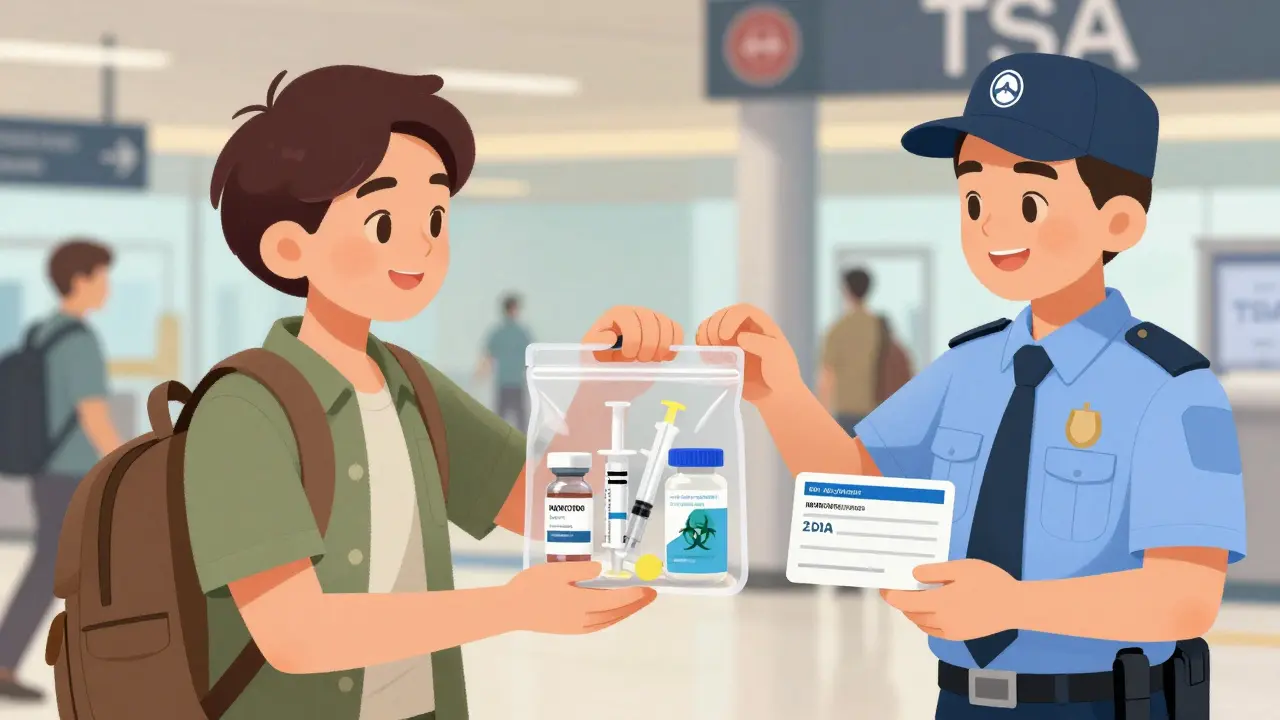
Traveling with injectable medications like insulin, EpiPens, or hormone therapies doesn’t have to be stressful-if you know the rules. Every year, millions of people fly with medical supplies, and most do so without issues. But confusion at security checkpoints can turn a smooth trip into a long delay. The key? Know what you can bring, how to pack it, and how to talk to TSA officers.
The TSA lets you carry injectables, syringes, and sharps on planes, no matter how much. There’s no limit on the number of vials, pens, or unused syringes if they’re for medical use. This includes insulin, glucagon, epinephrine, testosterone, and other prescribed injectables. Even if your medication exceeds the standard 3.4-ounce (100ml) liquid limit, you’re still allowed to bring it. The only requirement? It must be clearly for medical use.
Used syringes are also permitted, but they must be stored in an FDA-approved sharps container. These containers are rigid, puncture-resistant, and labeled with the universal biohazard symbol. You can buy them at any pharmacy-look for ones that meet ANSI/ISEA Z308.1-2021 standards. Never put loose needles in your purse, backpack, or carry-on. Flight crews have reported needlestick injuries from improperly stored sharps, and TSA takes this seriously.
Start by keeping everything in its original packaging. That means leaving insulin vials in their box, keeping EpiPen labels intact, and ensuring prescription bottles have your name and the pharmacy’s info. This helps TSA officers quickly confirm the items are legitimate. If you’ve transferred medication to a pill organizer or unlabeled container, you risk delays-or worse, confiscation.
For temperature-sensitive drugs like insulin, pack ice packs or gel packs. These are allowed without size limits, but they’ll need to be screened separately. Wrap them in a towel or place them in a sealed plastic bag to avoid water damage to other items. If you’re carrying an insulin pump or continuous glucose monitor, keep it on your body or in a clear, easily accessible bag. Don’t check it in luggage-temperature changes and pressure shifts can ruin the device.
At the checkpoint, don’t wait for TSA to ask. Proactively declare your medical items before you reach the X-ray machine. Say something like: “I have injectable medication and syringes for diabetes.” Most officers will nod and move on. But if they’re unsure, they’ll ask to see your items. Be calm, cooperative, and ready to explain.
Bring the TSA Notification Card (Form TSA-11-032). It’s a simple one-page sheet you can print or download from tsa.gov. It explains your medical needs in plain language and helps reduce misunderstandings. Passengers who use it report 29% fewer delays, according to TSA’s 2022 report. Even if you don’t use the card, having a doctor’s note (though not required) can help if questions arise.
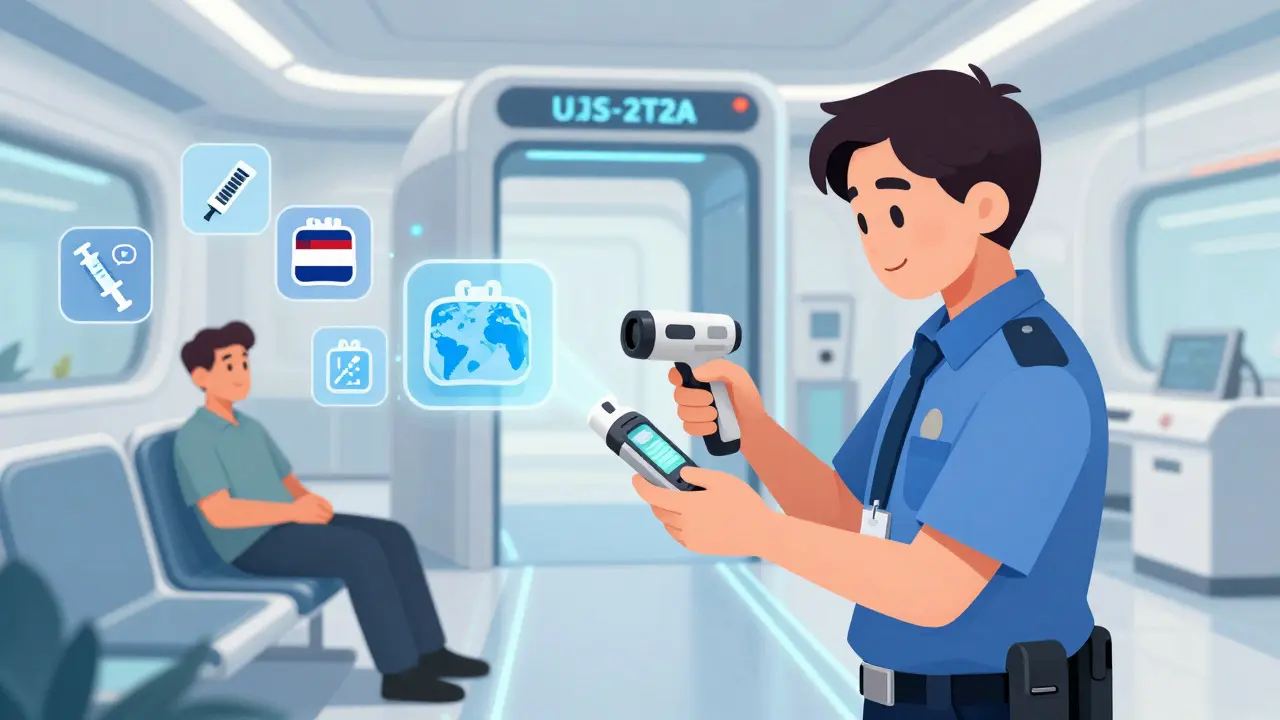
Request a visual inspection for your medications. You’re not required to let them X-ray insulin or other sensitive drugs. Say: “I’d prefer a visual check instead of X-ray.” Officers will usually accommodate this. If they insist on scanning, ask them to use a handheld scanner instead of the conveyor belt machine.
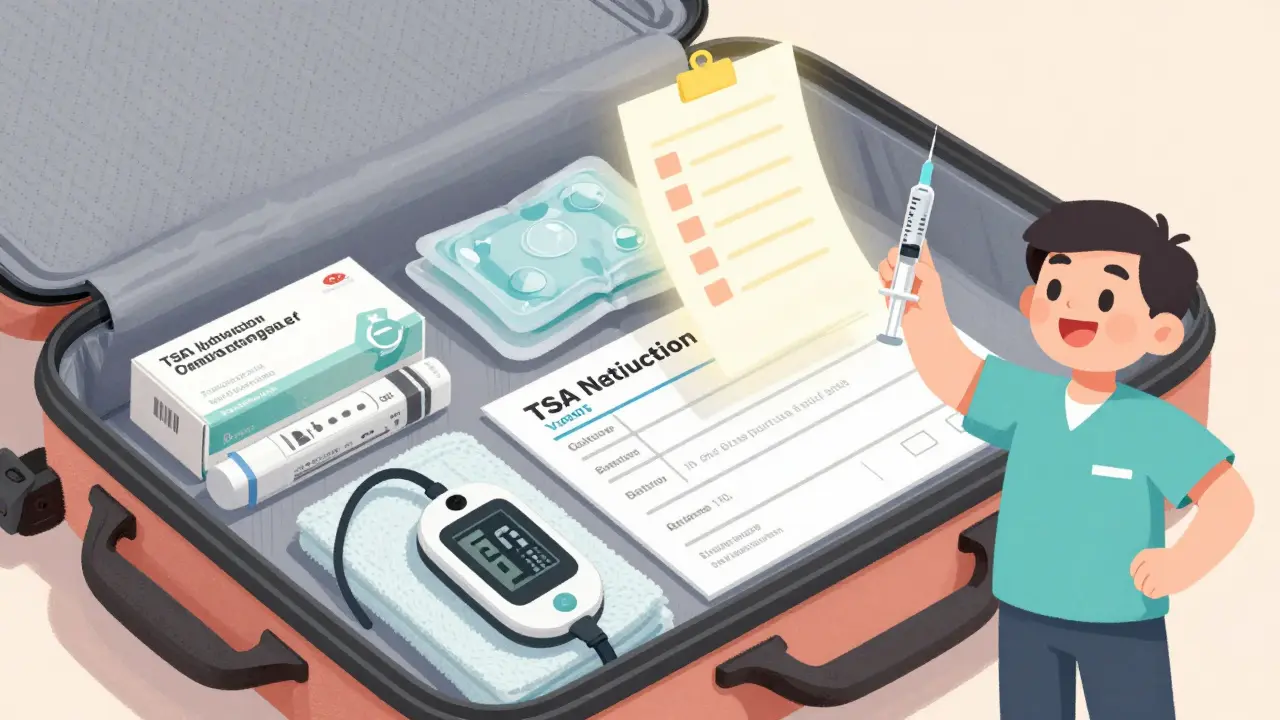
Domestic flights in the U.S. follow TSA rules-but international travel adds layers. In Europe, Canada, and Australia, you’ll still be allowed injectables, but some countries require documentation in the local language. Japan, for example, requires a special permit if you’re carrying more than 10 syringes. South Korea asks for a letter from your doctor in English or Korean. Always check the destination country’s rules at least 30 days before you fly.
When flying internationally, pack a copy of your prescription and a letter from your doctor. Include your name, diagnosis, medication name, dosage, and frequency. Translate it into the destination country’s language if possible. Airlines like United and Delta now offer downloadable medical travel templates on their websites. Use them.
Don’t hide your supplies. Trying to sneak syringes into a toiletry bag or tuck them under clothes will trigger alarms and extra screening. TSA officers are trained to spot medical items-but they also know when someone’s trying to conceal something.
Don’t rely on memory. Even if you’ve flown before, rules can change. TSA updated its medical screening guide in March 2023, and some airports are still catching up. Smaller airports with fewer than 5 million passengers annually have higher rates of inconsistent enforcement, according to a 2023 survey. Always prepare as if this is your first time.
Don’t forget backup supplies. Pack at least two extra days’ worth of medication and syringes in your carry-on. Flight delays happen. Layovers get extended. If you’re flying across time zones, adjust your dosing schedule ahead of time-but always keep your meds with you.
On Reddit, a traveler with Type 1 diabetes shared how she avoided a hospital trip during a 12-hour layover in Dubai after declaring her insulin and syringes using the TSA card. She was waved through quickly and even got help from a gate agent who recognized her supplies.
Another user on TripAdvisor reported that 82% of travelers who used proper sharps containers had no issues, compared to just 47% who used plastic bottles or ziplock bags. One man tried to carry 15 used syringes in a pill bottle-he was denied boarding until he bought a proper container at the airport pharmacy.
PreCheck members report faster screening. TSA’s data shows medical items go through PreCheck lanes 50% faster than standard lines. If you’re eligible, sign up. It’s not just for frequent flyers.
By early 2026, 50 major U.S. airports will have dedicated medical screening lanes. These lanes feature officers trained specifically to handle injectables, pumps, and sharps. They use handheld chemical scanners to identify medication components without opening containers. This reduces false alarms and cuts screening time by up to 40%.
The FAA is also investing $22.7 million in new screening tech to better distinguish between medication and illicit substances. Future updates may include biometric verification for medical travelers-think fingerprint or iris scan linked to your medical profile. But for now, the rules stay the same: if it’s prescribed, you can bring it.
You don’t need to be a medical expert to travel safely with injectables. Just be prepared. Know your supplies. Know the rules. And don’t be afraid to speak up. Millions do it every year-so can you.
No. TSA requires that all syringes be accompanied by the corresponding medication. Unused syringes without medication may be confiscated because they appear suspicious. Always keep your syringes with your insulin, EpiPen, or other prescribed injectable.
TSA does not require a doctor’s note. But having one can help if an officer questions your supplies. The note should include your name, diagnosis, medication name, dosage, and frequency. It’s not mandatory-but it’s a smart backup.
Yes. TSA allows unlimited ice packs and gel packs for temperature-sensitive medications like insulin. They may be screened separately, so keep them in a clear, sealed bag. Wrap them in a towel to prevent condensation on your other belongings.
If you forget your sharps container, TSA will usually let you purchase one at the airport pharmacy. Some airports have sharps disposal bins near security. Never put used needles in a plastic bottle, ziplock, or regular trash. That’s a safety risk and may delay your flight.
No. There is no limit on the amount of insulin or other injectable medication you can bring on a plane, as long as it’s for personal medical use. TSA permits enough for the entire trip plus extra in case of delays. Just make sure it’s labeled and declared.






13 Responses
Just flew last month with my insulin and pump. TSA agent actually high-fived me when I pulled out the notification card. Seriously, it’s that easy. Just be chill, declare it, and you’re golden. No drama.
Pro tip: Put your sharps container in a clear ziplock with your meds. Makes screening faster. I keep mine in my jacket pocket now. No more fumbling.
I dont trust the tsa at all. they have a hidden agenda. they scan everything but they dont tell you what theyre looking for. what if they start flagging insulin as a 'potential weapon' next year? i heard theyre testing AI that detects 'suspicious medical patterns'. i dont believe in 'rules'. i believe in control. dont let them get comfortable with your meds.
I used to panic every time i flew. Then i started using the notification card. Game changer. I even got a thank you note from a gate agent once.
Also, i carry my insulin in a small insulated pouch with a cold pack. No leaks, no melting. Just slide it into the bin and say 'medical device' and they nod and move on. Peace of mind is worth the 2 minutes it takes to prep.
lmao why are we even talking about this. just throw it in your bag and go. i carry 3 pens and 10 syringes in my wallet. no one cares. if they do, you're already late for your flight anyway. 😴
It is of profound significance that the human body, in its delicate, biochemical complexity, is permitted to traverse the skies with the very tools that sustain its existence. We are not merely passengers-we are living systems navigating an infrastructure built for the mundane. The fact that insulin, a molecule of life, is granted the same dignity as a bottle of water is nothing short of revolutionary.
Yet, the bureaucratic machinery that surrounds this right remains tragically inconsistent. A single misstep, a misplaced label, a moment of hesitation-and the sanctity of survival is momentarily suspended. We must not normalize this fragility.
so like the tsa says you can bring anything but then they confiscate stuff anyway and then you have to deal with some random officer who has no idea what an epipen is and then you get yelled at for being 'noncompliant' but you did everything right so like why are we even doing this why do we have to justify our survival to strangers who probably dont even take their own meds
I’ve been flying with diabetes for 17 years. The real lesson here isn’t about TSA rules-it’s about how society treats invisible illness. We’re expected to perform compliance, to prove our legitimacy, to carry paperwork like a badge of worthiness. Meanwhile, someone with a broken leg gets a wheelchair and a smile.
But we? We get scanned, questioned, stared at. The system doesn’t fail us-it was never designed to accommodate us. So we adapt. We print cards. We pack extras. We speak softly. And we keep flying. Not because it’s fair. But because we have no other choice.
As someone who travels frequently between India and the US, I can confirm that having a doctor’s letter translated into English and Hindi made all the difference. In Delhi, one officer didn’t understand 'insulin' until I drew a pancreas on a napkin.
Also, Indian pharmacies sell FDA-approved sharps containers for under $2. I buy 3 at a time and keep one in my carry-on, one in my checked bag, and one in my glove compartment. Always be prepared. And yes, PreCheck is worth every penny.
Oh please. You're all so dramatic. I've never once had an issue. I just toss my syringes in with my toothpaste. TSA doesn't care. They're not idiots. They see 10,000 people a day. If you're making a big deal out of it, you're the problem.
Also, 'TSA Notification Card'? How quaint. Next you'll be asking for a certificate of medical authenticity. Please. Just be normal.
The fact that we need a 12-point checklist to carry life-saving medication is a national disgrace.
It’s 2025. We have biometric passports, facial recognition, and AI-powered baggage scanners. Yet, a diabetic must print a form, carry a doctor’s note, and pray to the gods of airport security to be allowed to live.
I’m not impressed. I’m ashamed.
I keep my sharps container in a small ziplock with my boarding pass. One glance and they’re good to go. No questions.
Also-don’t forget to take your empty vials home. Some countries have strict rules about bringing them back. I’ve had them confiscated in Canada for 'biohazard contamination'. Just pack a small bag for disposal.
I've been following this for years... and I've seen the pattern... every time they 'update' the rules... it's always after someone got hurt... and they never fix the real problem... they just add more paperwork... and now they're talking about biometric verification... what's next... fingerprinting your insulin?... they're building a database... they're tracking who carries what... and who knows... maybe next year... they'll require a mental health clearance... just to carry your own blood sugar meds...
I don't understand why people make this so complicated. Just put your supplies in a bag. Say you have medicine. If they ask, show them. Done.
Stop printing forms. Stop carrying letters. Stop stressing. You're not a criminal. You're a person who needs insulin. That's it. No more. No less.