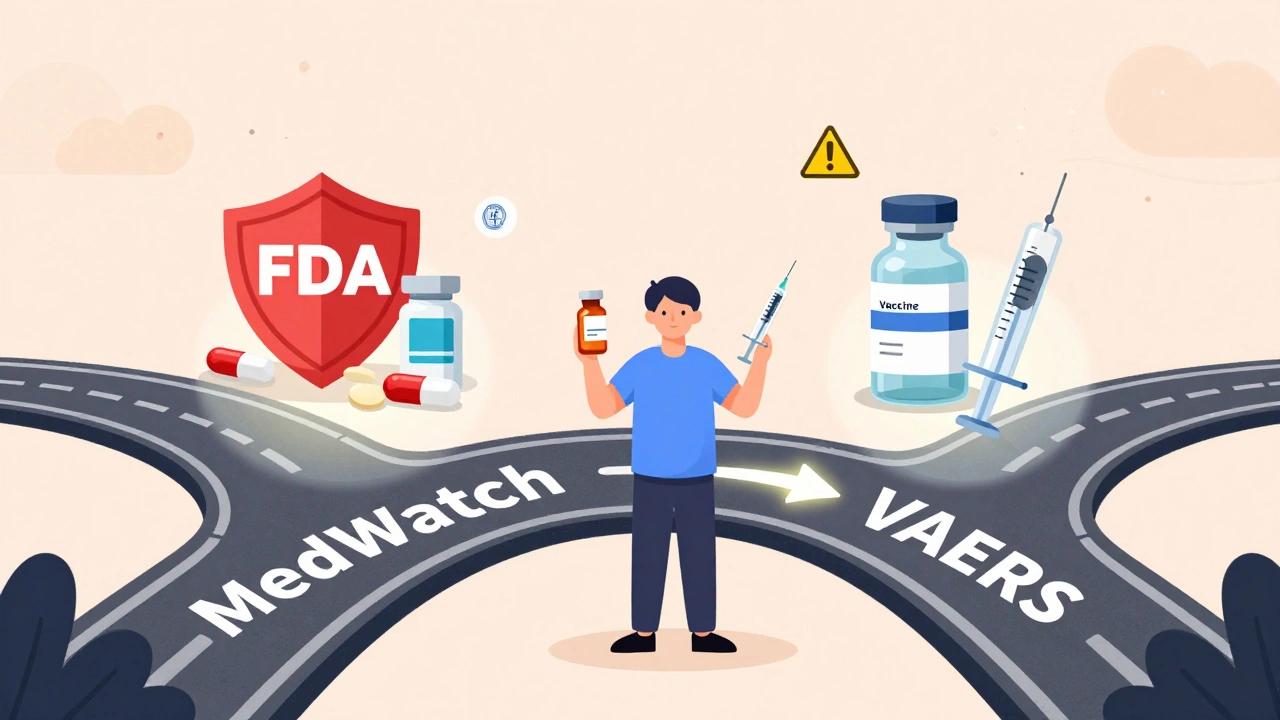
This tool helps you determine whether you should report a side effect to MedWatch (for drugs/devices) or VAERS (for vaccines). Correct reporting ensures your report reaches the right experts quickly.
When you or someone you know has a bad reaction after taking a medicine or getting a vaccine, you might wonder: where do you report this? The answer isn’t simple. Two systems exist - MedWatch and VAERS - and they’re not interchangeable. Mixing them up can delay important safety data from reaching the right people. If you’re a patient, a caregiver, or even a healthcare worker, knowing the difference isn’t just helpful - it’s necessary.
MedWatch is the FDA’s main system for tracking side effects from drugs, medical devices, and other non-vaccine products. Think of it as the catch-all reporting hub for everything that’s not a vaccine. That includes prescription pills, over-the-counter medicines, dietary supplements, insulin pumps, pacemakers, and even contact lenses.
Anyone can file a MedWatch report - patients, doctors, pharmacists, or family members. You don’t need proof that the product caused the problem. If you suspect a link, you report it. The FDA doesn’t wait for certainty. They look for patterns. One person reporting a rare rash after using a new cream might not mean much. But if 50 people report the same rash within weeks? That’s a signal.
Manufacturers are required by law to report serious side effects to MedWatch. If a drug company learns that one of their pills caused a heart attack in a patient, they must tell the FDA within 15 days. That’s not optional. But the system also relies heavily on voluntary reports from the public. In fact, over 60% of serious reports to MedWatch come from patients or providers, not companies.
What gets reported? Severe allergic reactions, liver damage from painkillers, bleeding from blood thinners, device malfunctions, or even unexpected weight loss after starting a new antidepressant. The key is seriousness - anything that leads to hospitalization, disability, or death. But even less severe issues matter if they’re unusual.
VAERS is the vaccine-only system. It’s run jointly by the CDC and FDA, and it’s designed for one thing: watching what happens after someone gets a shot. That includes flu shots, COVID boosters, HPV vaccines, childhood immunizations - anything approved for vaccination.
VAERS is open to everyone. Parents can report if their child gets a high fever after the MMR shot. A nurse can report if a patient passes out right after getting a tetanus booster. A retired doctor can report a strange neurological symptom that appeared two weeks after a shingles vaccine. You don’t need a diagnosis. You don’t need to be sure. You just need to notice something unusual.
VAERS collects data on everything from mild reactions - sore arms, low-grade fevers - to rare but serious outcomes like Guillain-Barré syndrome, anaphylaxis, or even death. The system is built for speed. It’s not meant to prove causation. It’s meant to catch signals early. If a new vaccine shows a spike in reports of seizures within 48 hours, VAERS flags it. Then, the CDC uses other systems - like the Vaccine Safety Datalink - to dig deeper with controlled studies.
Here’s the catch: VAERS reports are not proof of harm. A report of a headache after a flu shot doesn’t mean the vaccine caused it. Maybe the person was already getting a migraine. Maybe they were stressed. Maybe it’s a coincidence. VAERS doesn’t sort that out. That’s why experts say you can’t use VAERS data alone to say a vaccine is dangerous. But you can use it to say: “We need to look closer.”
The biggest difference? Scope. MedWatch covers drugs and devices. VAERS covers vaccines. That’s it. If you report a side effect from a COVID-19 vaccine to MedWatch, it won’t go where it needs to. It’ll get lost. The same goes for reporting a bad reaction to your blood pressure pill to VAERS - it won’t be seen by the right team.
Here’s a quick breakdown:
| Feature | MedWatch | VAERS |
|---|---|---|
| Managed by | Food and Drug Administration (FDA) | Centers for Disease Control and Prevention (CDC) and FDA |
| Covers | Drugs, medical devices, dietary supplements, tobacco products | Vaccines only |
| Who can report? | Patients, healthcare providers, manufacturers | Patients, parents, healthcare providers, manufacturers |
| Mandatory reporting? | Yes - manufacturers and facilities must report serious events | Yes - manufacturers must report, healthcare providers must report certain events |
| Reporting goal | Track safety of all non-vaccine medical products | Detect early warning signs for vaccine safety |
| Data use | Used to update labels, issue warnings, recall products | Used to trigger deeper studies via VSD, CISA, BEST |
| Underreporting rate | Estimated 1%-10% of serious events reported | Estimated under 1% of adverse events reported |
Another big difference: VAERS has stricter rules around what counts as a reportable event. For example, if a healthcare provider sees a patient develop a seizure after a vaccine, they’re required to report it - even if they think it’s unrelated. That’s not the case with most drugs in MedWatch. Providers aren’t legally required to report every side effect, unless it’s life-threatening or part of a specific list of events.
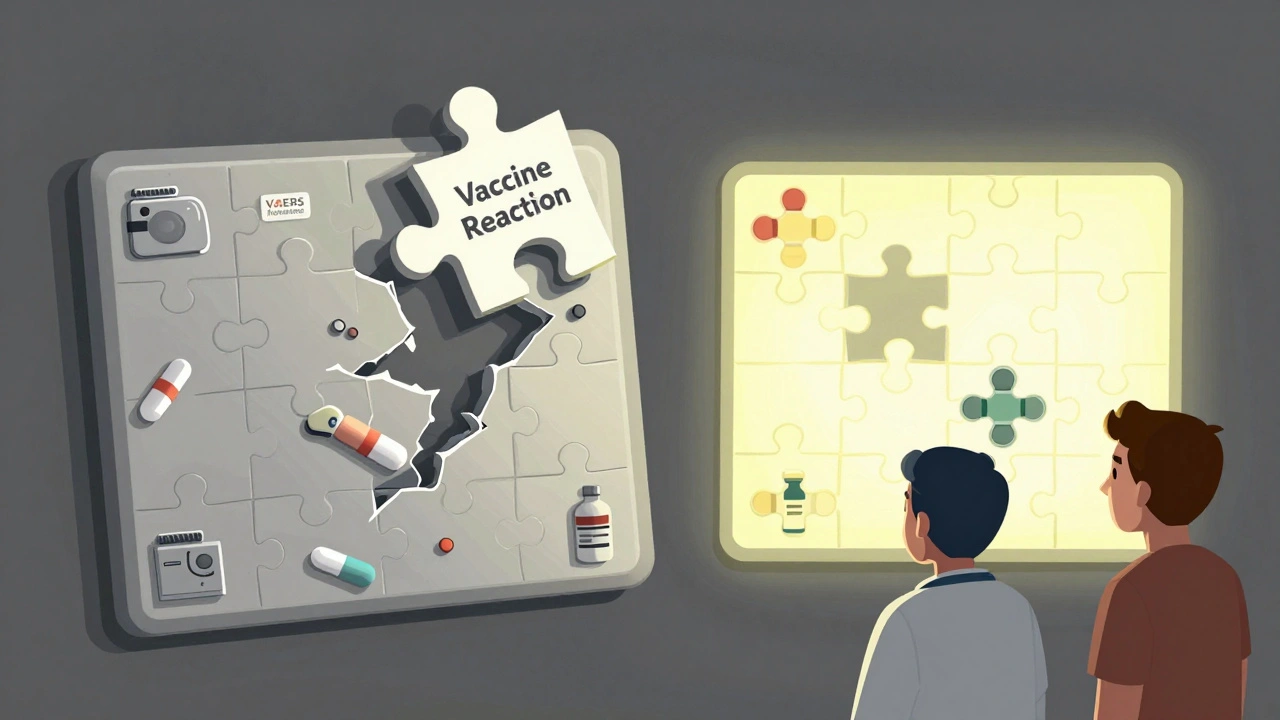
Imagine you take a new antibiotic and develop a severe skin rash. You go online, search “how to report side effects,” and land on the VAERS page. You fill out the form, thinking it’s the general reporting system. The report goes into the vaccine database. Nothing happens. The FDA doesn’t review vaccine reports for drug reactions. Your report vanishes into a system that doesn’t look at antibiotics.
Now imagine the same thing happens with a vaccine. You get the shingles shot and have a stroke two days later. You report it to MedWatch. The FDA gets it, but their drug safety team doesn’t have the tools to analyze vaccine data. They forward it to CDC. But now there’s a delay. The signal gets lost in the shuffle. Meanwhile, other people are having the same reaction - and no one sees the pattern.
Reporting to the wrong system doesn’t just waste your time. It delays safety responses. It means the FDA and CDC might miss early warnings. That’s why knowing which system to use isn’t a technical detail - it’s a public health responsibility.
Here’s the simple rule: If it’s a vaccine, use VAERS. If it’s anything else - pill, patch, inhaler, implant, supplement - use MedWatch.
To report to VAERS:
To report to MedWatch:
Both forms are free and take about 10-15 minutes. You don’t need medical records. You don’t need a doctor’s note. Just your best guess. The system is built for uncertainty.
After you submit, your report goes into a database. It’s not private - it’s public. Anyone can search VAERS or MedWatch data online. But that doesn’t mean every report is true or significant. Some are duplicates. Some are incomplete. Some are just coincidences.
What happens next depends on volume. If one person reports a headache after a flu shot, nothing changes. But if 200 people report the same headache after the same batch of vaccine? That’s a red flag. The CDC will pull medical records, compare vaccinated and unvaccinated groups, and run statistical tests. Only then do they decide if there’s a real risk.
For drugs, the FDA might update the label to warn about the side effect, require a boxed warning, or even pull the drug from the market. For vaccines, they might recommend changes in who gets the shot, add warnings, or pause use temporarily while they investigate.
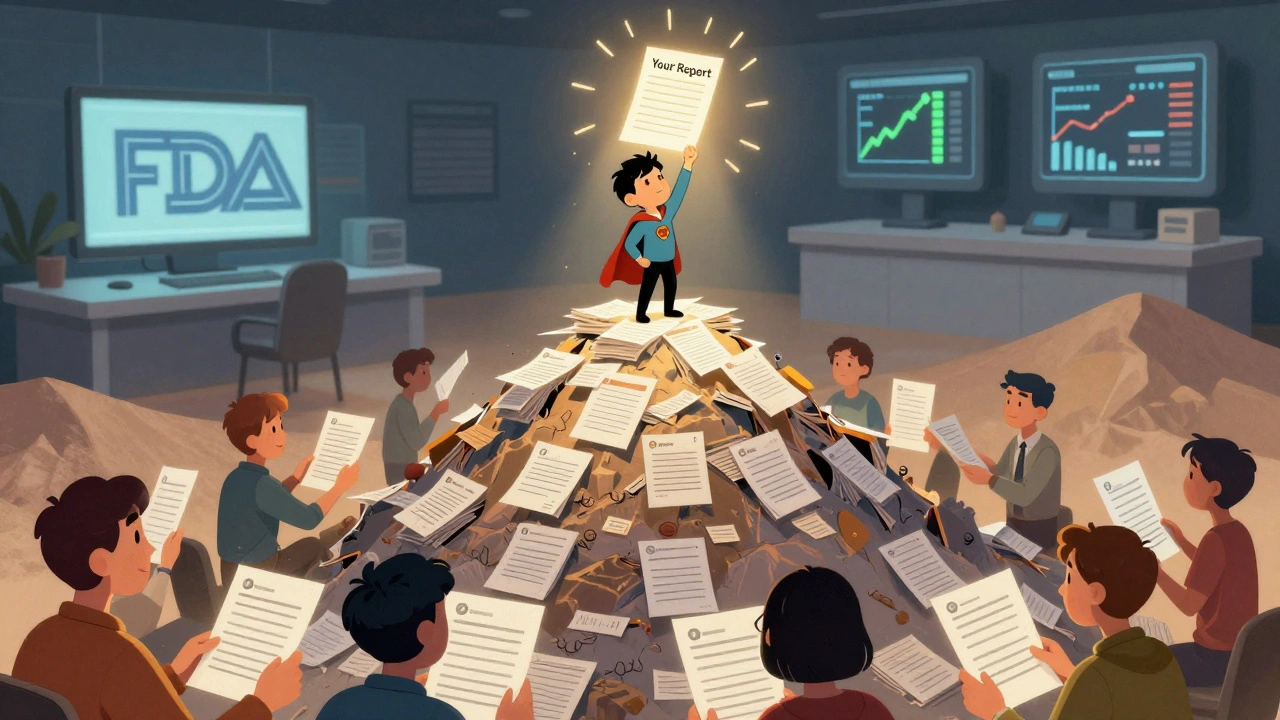
Your report could be the first domino in a chain that saves lives.
There’s a lot of noise online about these systems. Here’s what’s not true:
Understanding these systems isn’t about fear. It’s about clarity. The goal isn’t to prove vaccines or drugs are dangerous. It’s to make sure they’re as safe as possible.
Don’t wait for certainty. Don’t think, “It’s probably nothing.” If something unusual happened after taking a medicine or getting a shot, report it. Here are some real examples that led to safety updates:
Your report could be one of those turning points.
MedWatch and VAERS are quiet heroes in public health. They don’t make headlines. But they prevent disasters. They help fix unsafe drugs before more people get hurt. They help adjust vaccine schedules before a whole generation is affected.
You don’t need to be a scientist to use them. You just need to pay attention. If you notice something off after taking a pill or getting a shot - report it. Use the right system. Don’t guess. Don’t wait. Your report might not change your life. But it could change someone else’s.
Yes. Both MedWatch and VAERS are designed for uncertainty. You don’t need to prove causation. If you suspect a link - even if you think it’s a coincidence - report it. The systems are built to catch patterns, not confirm individual cases.
Your report may still be reviewed, but it will be delayed. MedWatch is not set up to analyze vaccine data the same way VAERS is. Reports sent to the wrong system can take weeks to be redirected, which slows down safety investigations. Always use VAERS for vaccines and MedWatch for everything else.
They’re not meant to capture every single side effect. They’re early warning systems. Even with underreporting - estimated at less than 1% for vaccines - they’ve caught serious issues like myocarditis after mRNA vaccines and intussusception after rotavirus vaccines. Their strength is in spotting unusual patterns, not counting every case.
No. Both systems allow anonymous reporting. But if you leave contact information, investigators might reach out for more details if your report stands out. It’s optional, but helpful.
Yes. There’s no time limit. If you recently realized a health issue might be linked to a drug or vaccine you took years ago, report it. Historical data helps scientists understand long-term risks and rare delayed reactions.
Not at all. One report rarely causes change. But thousands of reports build a picture. Many safety actions - like label changes or vaccine updates - started with just a few early reports. Your report adds to the data. It might not change things today, but it helps protect people tomorrow.




10 Responses
Man, I had no idea MedWatch and VAERS were this different. I reported my kid’s rash after the MMR shot on VAERS last year, but I thought it was just the ‘general side effect portal.’ Glad I found this - now I know to use MedWatch for his new ADHD med. Small thing, but could matter.
It is imperative to underscore the operational dichotomy between MedWatch and VAERS, as their respective surveillance architectures are designed with divergent epistemological frameworks. MedWatch operates under a pharmacovigilance paradigm predicated upon non-vaccine medical product surveillance, whereas VAERS is a vaccine-specific signal detection system governed by the CDC-FDA joint mandate. Failure to align reporting modalities with jurisdictional boundaries introduces systemic noise into signal-to-noise ratios, thereby compromising the temporal sensitivity of adverse event triangulation.
Furthermore, the underreporting rates - estimated at <1% for VAERS and 1–10% for MedWatch - suggest a profound latent data gap that necessitates enhanced public education campaigns. The absence of mandatory provider reporting for non-life-threatening events in MedWatch constitutes a structural vulnerability in longitudinal safety monitoring.
It is also noteworthy that VAERS mandates reporting of certain events by healthcare professionals under the National Childhood Vaccine Injury Act, whereas MedWatch imposes mandatory reporting only on manufacturers for serious adverse events. This asymmetry in accountability structures warrants policy recalibration.
people just report stuff because they’re scared, not because it’s real. i saw a guy report his headache after the shot and now it’s ‘proof’ the vaccine is dangerous. smh. you don’t get to make science up because you feel weird.
Let me be perfectly clear: these systems are not safety tools - they are data collection vessels for the pharmaceutical-industrial complex. VAERS? A trap. MedWatch? A smokescreen. Every report is weaponized to justify future mandates, not to protect you. The fact that you can report anonymously? That’s because they know most of it’s garbage - and they want you to keep feeding it.
Why don’t they fix the underreporting? Because if they did, the numbers would be too scary. They need you to think it’s ‘only 1%’ - so you don’t panic. Wake up.
Bro, I used to think reporting side effects was for doctors only - until my buddy had a wild reaction to his new blood pressure pill. We filled out MedWatch in 12 minutes, no docs, no stress. And guess what? Three months later, the FDA added a warning. That’s wild. You don’t need to be a scientist. You just need to care enough to hit submit.
Don’t overthink it. If it feels off, report it. VAERS for shots. MedWatch for pills. Boom. You just helped someone who hasn’t even been born yet.
I’ve been in public health for 22 years, and I still see people mixing up VAERS and MedWatch - even some nurses. The confusion isn’t just annoying, it’s dangerous. I’ve had patients come in with printouts from VAERS claiming their statin caused heart attacks because someone else reported it there. No. That’s like blaming a fire alarm for the fire. The system isn’t broken - we’re just using the wrong tool. And the fact that both systems are free, anonymous, and open to anyone? That’s a gift. Use it right.
One of the biggest wins in my career? A nurse reported a rare skin reaction to a generic antibiotic. It was the third report. We dug in. Turned out the filler in that batch was triggering it. They pulled it. Saved dozens from hospitalization. All because someone didn’t say ‘it’s probably nothing.’
It’s fascinating how these systems embody a tension between individual experience and population-level science. One person’s ‘unusual headache’ is noise until it becomes a pattern - but the pattern only emerges because individuals dared to report what felt insignificant. There’s a quiet courage in submitting a report when you’re unsure. It’s an act of trust - in the system, in science, in collective vigilance.
And yet, the epistemic humility required is immense. We must hold space for uncertainty: the report is not proof, but a prompt. The data is not truth, but a question. This is how science actually works - not with certainty, but with cautious curiosity.
I wonder if the real failure isn’t underreporting, but our cultural impatience with ambiguity. We want answers now. But safety science moves in whispers, not shouts.
My grandma took a new supplement and got dizzy. She didn’t tell anyone - thought it was just old age. Then she saw this article and reported it to MedWatch. Six months later, the FDA issued a warning about that exact ingredient in 3 other brands. She didn’t even know she was part of a bigger story. I cried when I found out. That’s the thing - your quiet report might be the one that saves someone’s mom.
why do i even care?? i just want my meds to work. this whole thing is so much work. can't someone just fix the damn stuff instead of making me fill out forms? 🤡
VAERS is a LIST of EVERYTHING people say happened after a shot - including heart attacks, miscarriages, autism, and people who said they turned into lizards. The CDC admits they don’t verify ANY of it. So why do you trust it? Why do you trust ANYTHING the FDA says? They approved Vioxx. They approved OxyContin. They approved the J&J vaccine with a black box warning for blood clots - and STILL told us it was ‘safe.’
They’re not protecting you. They’re protecting profits. And you’re helping them by reporting. You’re feeding the machine that lies to you. Wake up. Don’t report. Don’t participate. Burn the forms.