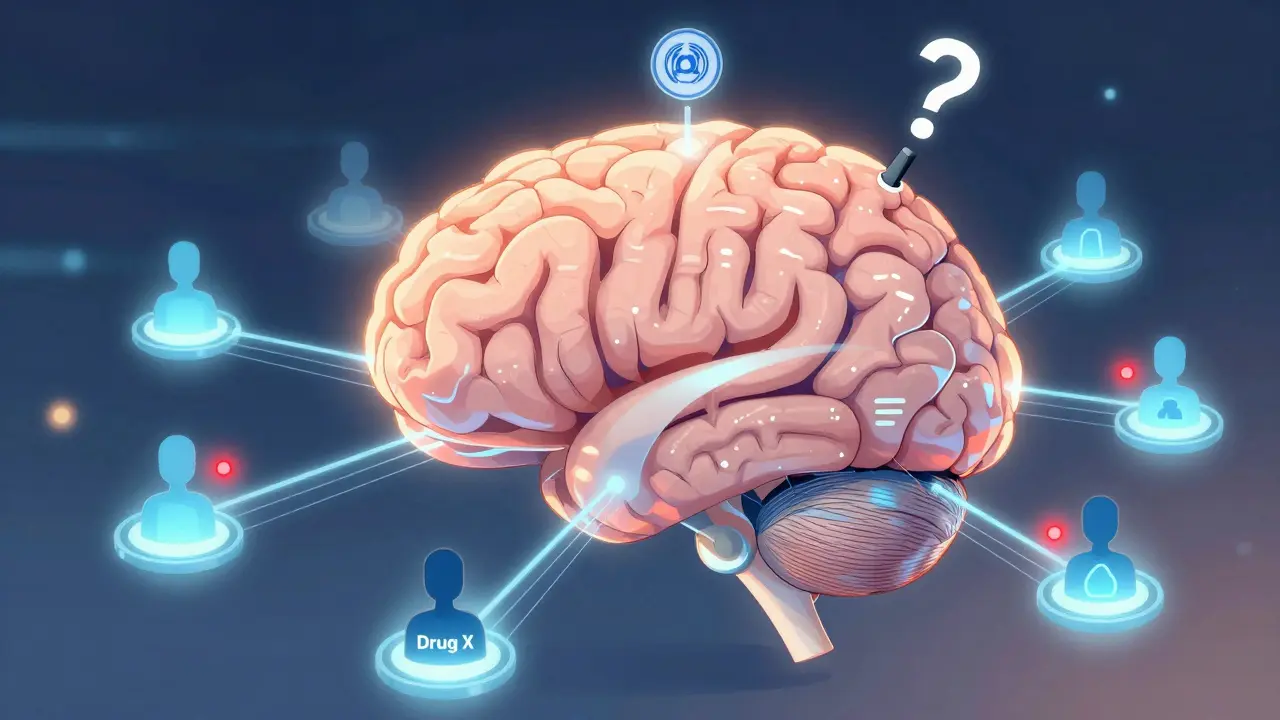
The FDA Sentinel Initiative uses real-world data from over 20 data partners covering 300+ million patient records (90% of U.S. population with health coverage). Unlike FAERS, Sentinel knows exactly how many people were exposed to a drug, allowing it to calculate the true risk of adverse events.
Comparing Sentinel vs. FAERS detection capabilities
Actual adverse events: 0
Reported cases: 0
Detected rate: 0%
Actual adverse events: 0
Detected cases: 0
Detected rate: 0%
Important Note: FAERS only detects about 1-10% of adverse events, while Sentinel can detect the true incidence rate by using denominator data from real-world patient records. This tool illustrates the magnitude of underreporting with traditional systems.
The U.S. Food and Drug Administration doesn’t wait for patients to get hurt before acting. Instead, it uses big data to catch problems before they spread. This is the heart of the FDA Sentinel Initiative - a national system that monitors the safety of drugs, vaccines, and medical devices after they’ve been approved and are being used by millions of people.
Before Sentinel, the FDA relied mostly on voluntary reports from doctors and patients through the FDA Adverse Event Reporting System (FAERS). But this system had big gaps. Only about 1% to 10% of serious side effects get reported. Many people don’t know they should report a reaction. Others don’t connect a new symptom to a medication they took months ago. And even when reports come in, the FDA rarely knew how many people were using the drug in the first place - making it hard to tell if a side effect was rare or common.
Sentinel changed all that. Launched in 2016 after years of testing, it doesn’t collect data in one place. Instead, it asks trusted partners - like insurance companies, hospital systems, and clinics - to run queries on their own data. The data never leaves their servers. The FDA sends a question: "Did more people taking Drug X have a stroke in the last 90 days compared to those taking Drug Y?" Then, each partner runs the same analysis on their own records and sends back only the results. No names. No personal details. Just numbers.
The system runs on a network of over 20 Data Partners, covering more than 300 million patient records - about 90% of the U.S. population with health coverage. These partners include giants like Kaiser Permanente, Humana, and Optum, as well as smaller regional health systems. Each one uses electronic health records (EHRs) and insurance claims data. Claims data tells you what was billed - a prescription filled, a hospital visit, a lab test. EHRs go deeper: they include doctor’s notes, lab results, vital signs, and even diagnoses written in free text.
The magic happens because every partner uses the same software tools. This means the same question gets answered the same way everywhere. If one hospital finds 15 cases of liver injury linked to a diabetes drug, and another finds 12, the FDA can combine those numbers with confidence. That’s something you can’t do with FAERS, where reports come in messy, inconsistent, and unverified.
When a red flag pops up - maybe a spike in heart attacks after a new blood thinner hits the market - Sentinel can respond in weeks, not years. Traditional studies take time to design, fund, recruit patients, and wait for outcomes. Sentinel already has the data. It just needs the right question.
Early on, Sentinel mostly used insurance claims. That gave it a broad view but a shallow one. It knew someone got a prescription, but not why. Was the drug prescribed for high blood pressure? Or for an off-label use? Did the patient have kidney disease? Those details matter.
Starting in 2019, the FDA pushed hard to add EHR data. Today, over 89% of U.S. hospitals use certified electronic health record systems. Sentinel’s Innovation Center now works with partners to extract meaning from unstructured notes - like a doctor writing, "Patient reports muscle pain after starting statin." That kind of detail used to be invisible. Now, natural language processing (NLP) tools scan thousands of notes to find patterns. Is muscle pain happening more often with one statin than another? Are older patients more at risk? These insights help the FDA make smarter decisions.
The Innovation Center has four main goals: better data infrastructure, smarter ways to turn raw data into usable signals, stronger methods to prove cause-and-effect, and faster ways to detect hidden risks. They’re even using machine learning to predict which drugs might be risky before large-scale problems emerge.
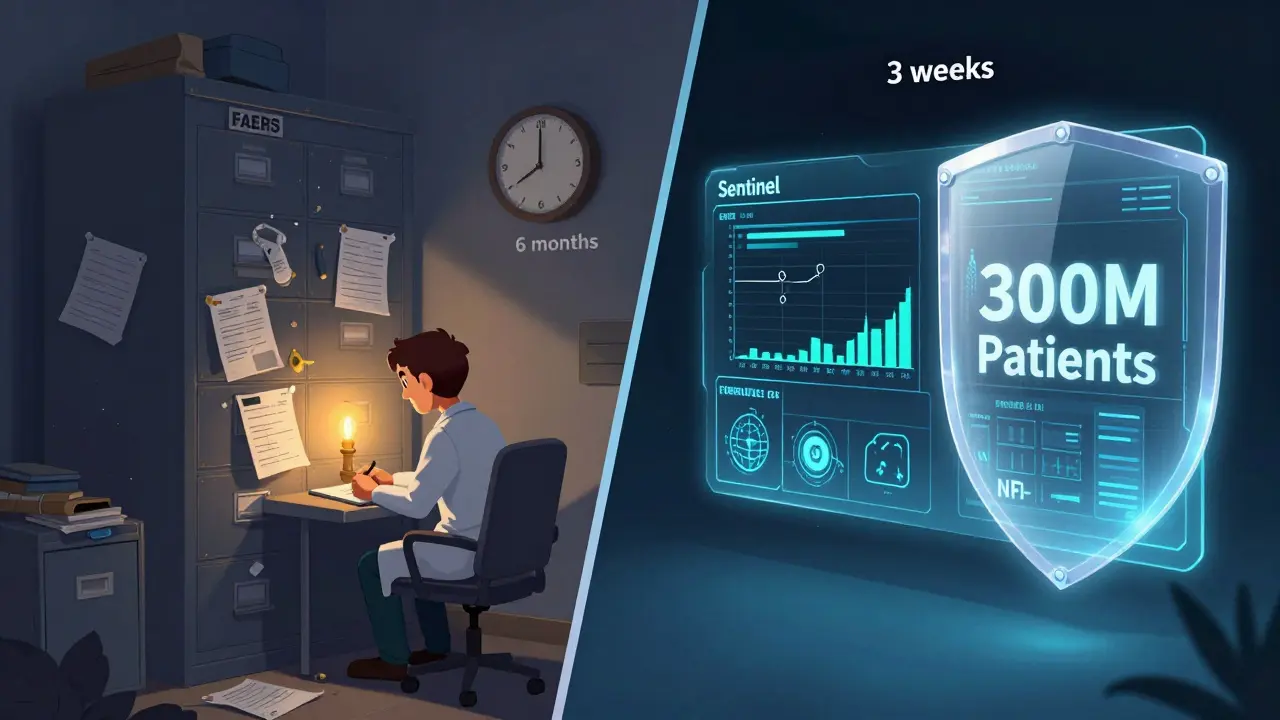
This isn’t theory. Sentinel has directly influenced FDA actions:
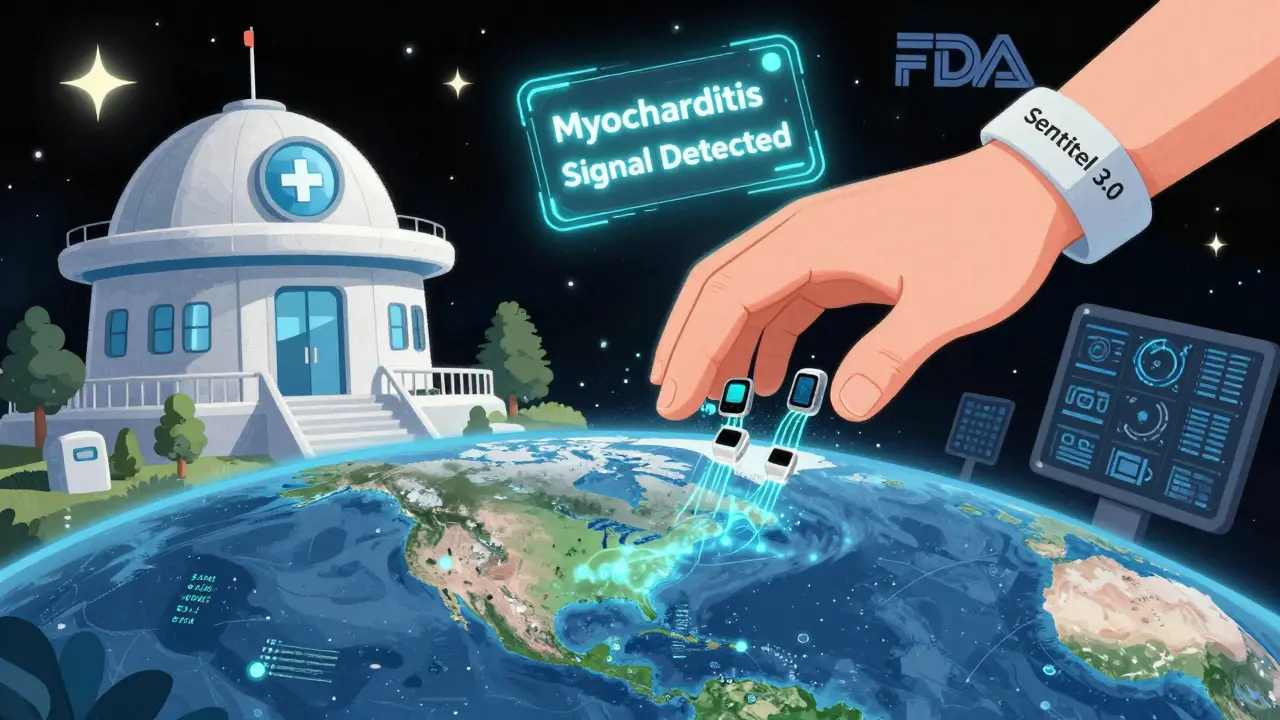
One of the most powerful tools built on Sentinel is PRISM - the Postmarket Rapid Immunization Safety Monitoring system. It tracks vaccine safety in near real-time. During the COVID-19 pandemic, PRISM helped detect rare cases of myocarditis in young men after mRNA vaccines. The FDA used that data to update recommendations within weeks - saving lives by balancing risk and benefit.
Compare Sentinel to FAERS:
| Feature | FDA Sentinel | FAERS (Traditional Reporting) |
|---|---|---|
| Data Source | Millions of real-world patient records | Voluntary reports from doctors and patients |
| Denominator Data | Yes - knows how many people used the drug | No - only counts reports, not total users |
| Speed | Weeks to detect signals | Months to years |
| Detail | Includes lab results, diagnoses, prescriptions | Basic symptom descriptions |
| Verification | Data quality checked before analysis | Reports often unverified |
| Population Coverage | Includes elderly, children, pregnant women | Underrepresents vulnerable groups |
Sentinel doesn’t just find problems - it finds them faster, in more people, with more context. It’s especially good at spotting risks in older adults, pregnant women, and people with multiple chronic conditions - groups often left out of clinical trials.
It’s not perfect. One big issue: EHR data is messy. One doctor writes "hypertension," another writes "high BP." One system codes a heart attack as I21, another as I22. The Innovation Center spends a lot of time standardizing these terms.
Also, Sentinel only sees what happens inside the healthcare system. If someone has a side effect but never goes to a doctor - or if they go to an out-of-network clinic that doesn’t share data - it won’t show up. Mental health events, substance use, or symptoms dismissed as "normal aging" often go unnoticed.
And while Sentinel can find patterns, proving a drug caused a problem still takes careful analysis. Just because two things happen together doesn’t mean one caused the other. That’s why the Innovation Center runs "emulated trials" - using real-world data to mimic the design of a clinical trial and test whether the signal holds up.
The system is evolving fast. In 2023, the FDA announced a major funding boost - $304 million - to upgrade Sentinel into what some call "Sentinel 3.0." This version will:
Experts call Sentinel a "learning health system" - one that gets smarter as it uses more data. Dr. Robert Ball, former FDA director, said it could become the blueprint for how the world monitors drug safety. Other countries - like the UK, Canada, and Australia - are now building their own versions.
The bottom line? Sentinel isn’t just a tool. It’s a shift in how medicine stays safe. Instead of waiting for harm, it watches for it - in real time, across millions of lives. And that’s how we protect public health in the age of big data.
FAERS relies on voluntary reports from doctors and patients, which often miss cases, lack context, and don’t include how many people used the drug. Sentinel uses real-world data from millions of patient records, knows exactly how many people were exposed, and can detect patterns faster and more accurately. It’s proactive, not reactive.
No. Sentinel never moves personal data to a central location. Data stays with each partner - like a hospital or insurance company. The FDA sends a coded query, and the partner runs it locally. Only aggregated results - like "15 more cases of liver injury among 500,000 users" - are shared. No names, Social Security numbers, or addresses are ever transferred.
Patients don’t directly opt in or out. Sentinel uses existing healthcare data that partners already collect for billing and care. But each partner follows federal privacy rules (HIPAA) and may offer patients the right to opt out of research use of their data - just like any other health study. The FDA doesn’t have access to individual records.
It can take as little as 2 to 6 weeks to analyze a signal once a question is asked. That’s much faster than traditional studies, which can take years. For example, during the pandemic, Sentinel identified rare heart inflammation after mRNA vaccines in under a month, helping the FDA update safety guidance quickly.
The FDA oversees Sentinel, but it’s run by a network of partners. The Sentinel Operations Center handles day-to-day queries. The Innovation Center develops new tools. The Community Building Center connects with researchers and data partners. Harvard Pilgrim Health Care helped launch the system, but today, multiple academic and private organizations manage parts of it under FDA oversight.


14 Responses
I love how Sentinel just... works in the background like a quiet guardian. 🛡️❤️ No drama, no panic, just numbers adding up to save lives. I used to think drug safety was all about lawsuits and headlines - turns out it’s more like a giant, invisible net catching problems before they fall. Thank you, data nerds.
This is actually kind of beautiful if you think about it. All these systems talking to each other without ever sharing names. Its like a secret society of hospitals saving us all. Just wish more people knew about this. Maybe we should make a meme?
Fascinating stuff. The idea of distributed analysis is genius. Keeps privacy intact while still giving us actionable insights. Though I wonder how well it handles rural areas where EHR adoption is patchy. Still... impressive.
America built this. Not Europe. Not China. WE DID. And we did it right. 🇺🇸👏 The fact that we can track side effects across 300 MILLION people without violating privacy? That’s not just tech - that’s American ingenuity at its finest. Other countries are still stuck in the 90s.
So let me get this straight... we're using AI to read doctors' scribbles like they're ancient scrolls and calling it 'science'? 😏 Meanwhile, FAERS still relies on people remembering that weird rash they got 3 months after taking that pill. Classic. We’re basically training computers to be better psychiatrists than actual humans. 🤖💊
Very interesting. In India, we still rely mostly on voluntary reporting. The gap between what's reported and what actually happens is huge. Sentinel seems like a leap forward. I hope some of these methods can be adapted here, even if scaled down.
The ethical framework behind Sentinel is commendable. Data sovereignty, minimal exposure, and algorithmic transparency are critical pillars in modern public health infrastructure. This model should serve as a template for global regulatory cooperation.
I just... wow. This is the future. I mean, really. Imagine if we applied this to mental health? Or chronic pain? Or long COVID? The possibilities are endless. And it’s all happening. Right now. In real time. 😍
This is what we need more of - systems that protect people instead of waiting for them to break. In India, we lose so many to unmonitored drug interactions. If something like this could be made affordable and open-source... imagine the impact. We can learn from this.
Why are we even talking about this like it’s a miracle? It’s just common sense. The old system was a joke. People still die because we didn’t connect the dots. Now we do. Why isn’t this on the nightly news? Why isn’t every drug company terrified?
Let’s be real - this isn’t magic. It’s just capitalism with a stethoscope. Pharma companies didn’t fund this because they’re angels. They’re scared. Sentinel’s got teeth. And now, every time they release a new drug, they’re sweating bullets wondering if the algorithm will catch them. 😈📊
This... this is the pinnacle of modern medical governance. A symphony of data, ethics, and technological precision. The FDA, in its quiet, unassuming brilliance, has constructed a cathedral of safety - one that hums with the collective pulse of 300 million lives. We stand on the shoulders of giants who coded, curated, and protected. This is not just innovation. It is transcendence.
In Tamil Nadu, we have a saying: 'The river knows the depth before the stone falls.' Sentinel is that river. Quiet, deep, always watching. We don't need loud alarms. We need systems that see before the scream. This is wisdom in code.
The distributed architecture is brilliant. It respects privacy while maximizing utility. This is a textbook example of how public institutions can leverage private data responsibly. A model worth emulating globally.