
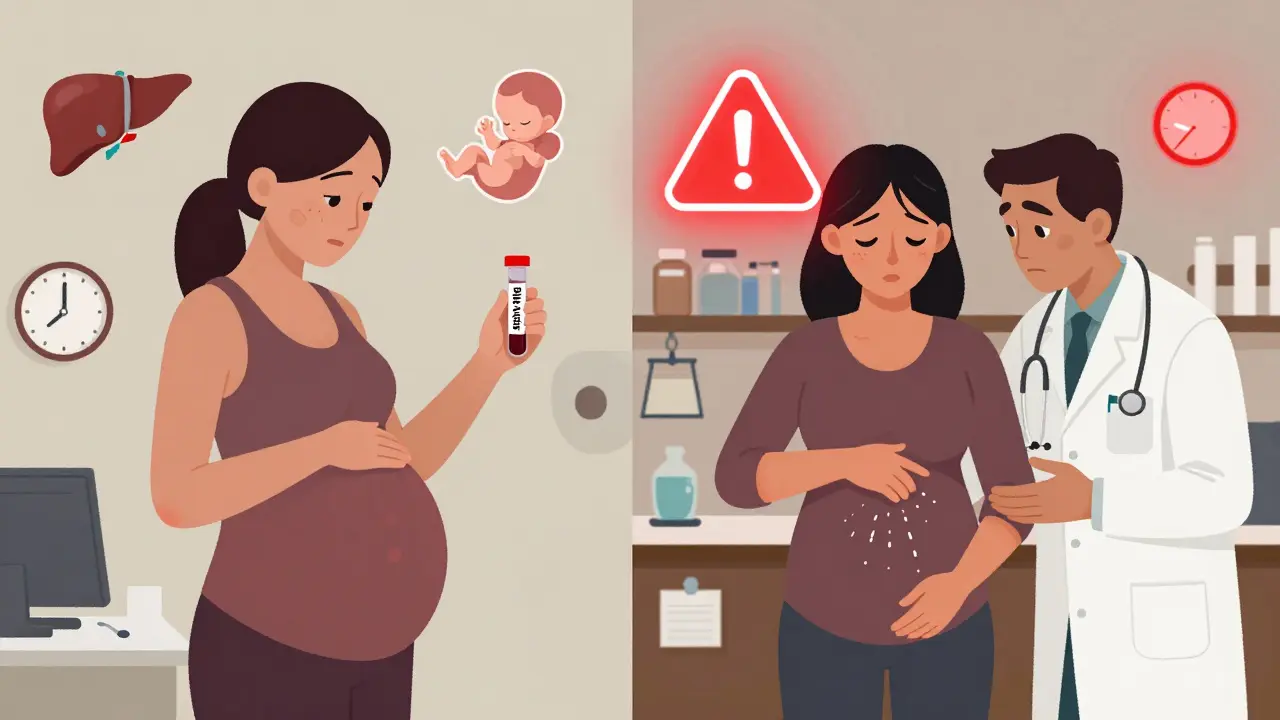
When you're pregnant, your body goes through a lot of changes. But one change that doesn't get talked about enough is how pregnancy can affect your liver. A condition called intrahepatic cholestasis of pregnancy (ICP) can show up in the second or third trimester, and while it doesn't hurt the mother much, it can put the baby at serious risk. If you're experiencing intense itching - especially on your hands and feet - without a rash, it's not just dry skin. It could be ICP.
ICP, sometimes called obstetric cholestasis, happens when pregnancy hormones - mainly estrogen - slow down the flow of bile from your liver. Bile helps digest food, and when it builds up in your blood, it causes itching and can raise your risk of stillbirth. This isn't something you caused. It's a genetic sensitivity combined with hormonal shifts that turn a normal liver function into a dangerous one.
The condition shows up in about 1 to 2 out of every 1,000 pregnancies in the U.S., but that number jumps dramatically depending on where you live. In Chile, it affects nearly 1 in 6 pregnant women. In Scandinavian countries, rates are lower, but screening is routine. In the U.S., many doctors don't test unless you complain of itching - which means diagnosis often comes too late.
The main sign is intense, unrelenting itching. It usually starts on the palms and soles, then spreads. It gets worse at night and doesn't go away with lotions or antihistamines. No rash. No bumps. Just itching that keeps you up and drives you crazy.
That’s why doctors test for bile acids. The gold standard is a blood test measuring serum bile acid levels. If your levels are above 10 µmol/L, you have ICP. Mild cases are under 40 µmol/L. Severe cases are over 100 µmol/L - and that’s when stillbirth risk jumps from under 0.3% to over 3%. A 2021 study in the Journal of Hepatology showed that women with bile acids over 100 had a 12 times higher risk of stillbirth compared to those under 100.
Liver enzymes like ALT and AST are often elevated too - in 60 to 70% of cases. But those alone don’t diagnose ICP. Many healthy pregnant women have slightly high enzymes. Only bile acid levels confirm it.
Some women are more likely to get ICP. If you’re carrying twins or triplets, your risk goes up 3 to 5 times. If you got pregnant through IVF, your risk doubles. If your mom or sister had ICP, you’re 12 to 15 times more likely to get it. And if you’re of Latina descent, your risk is much higher - up to 5.6% in some populations.
It also tends to come back in future pregnancies. If you had ICP once, you have a 60 to 70% chance of getting it again. That’s why doctors now ask about past pregnancies when you’re pregnant again.
There are other liver issues during pregnancy, like acute fatty liver of pregnancy (AFLP) and HELLP syndrome. But they’re different. AFLP causes nausea, vomiting, and confusion. HELLP comes with high blood pressure, headaches, and swelling - signs of preeclampsia. ICP doesn’t cause any of that. No hypertension. No swelling. Just itching and elevated bile acids.
That’s why misdiagnosis happens. Some women are told it’s just pregnancy skin changes. Others are sent for allergy tests. But if your itching is bad, persistent, and worse at night - and you’re past 28 weeks - ask for a bile acid test. Don’t wait.
The first-line treatment is ursodeoxycholic acid (UDCA), given at 10 to 15 mg per kilogram of body weight per day. It’s safe for the baby. It reduces itching by about 70%. It may also lower the chance of preterm birth by 25%.
But here’s the catch: a 2022 Cochrane Review of 19 studies found no clear proof that UDCA reduces stillbirth. That doesn’t mean it doesn’t help - it means we need more data. Still, most maternal-fetal medicine teams use it because it’s safe, effective for symptoms, and there’s no better option.
Another option is S-adenosyl methionine (SAMe), at 800 to 1,600 mg daily. It’s used if UDCA doesn’t work or causes side effects. Small studies show it cuts itching by 40 to 50%. But it’s expensive and not widely available.
Cholestyramine, an older bile acid binder, is sometimes used. But it can block vitamin K absorption - which increases bleeding risk after delivery. That’s why many doctors avoid it unless absolutely necessary.
ICP doesn’t stay the same. Bile acid levels can spike in just two weeks. One study found that 30% of women with mild ICP go from under 40 µmol/L to over 100 µmol/L in 14 days. That’s why monitoring every 1 to 2 weeks is critical.
Starting at 32 to 34 weeks, you’ll need non-stress tests twice a week. These check your baby’s heart rate in response to movement. If your bile acids are high, your doctor might recommend weekly ultrasounds to check amniotic fluid levels.
In the U.S., only 42% of OB-GYN practices screen routinely. But in Sweden, since 2018, all pregnant women get a bile acid test in the third trimester. The result? A 35% drop in ICP-related stillbirths.
Delivery timing depends on your bile acid levels. For mild ICP (under 40 µmol/L), most guidelines recommend delivery at 37 to 38 weeks. For severe ICP (over 100 µmol/L), delivery between 34 and 36 weeks is often advised.
But new data from the 2024 International Cholestasis of Pregnancy Consensus Statement suggests that with tight monitoring and UDCA, stillbirth risk stays below 0.5% even if you deliver at 38 weeks - as long as your bile acids stay under 40. That could mean fewer unnecessary early deliveries.
Still, if your levels climb fast, or if fetal monitoring looks worrisome, your doctor may recommend delivering earlier. The goal isn’t to rush delivery - it’s to prevent tragedy.
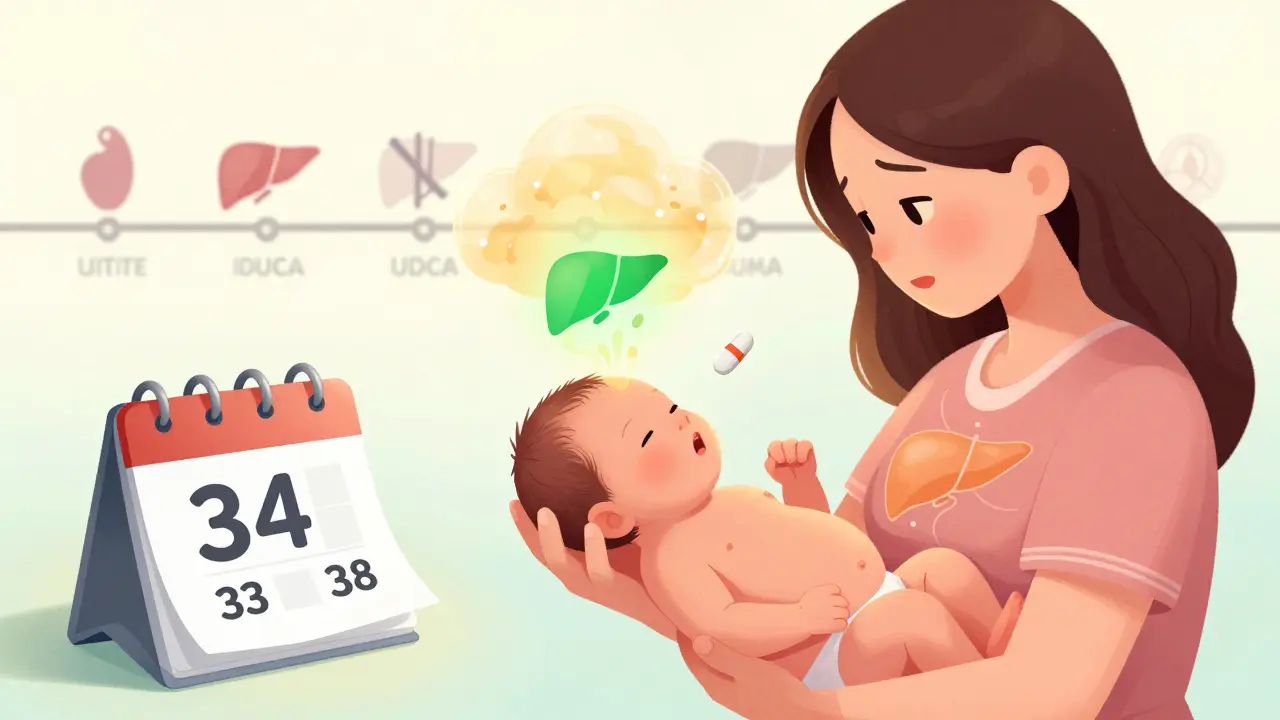
Good news: ICP goes away quickly after delivery. In 95% of cases, itching fades within 1 to 3 days. Liver enzymes and bile acids return to normal within a few weeks.
But here’s the long-term warning: women who had ICP are 3.2 times more likely to develop liver problems later in life - including gallstones, chronic hepatitis, and even hepatitis C. That’s not a guarantee. But it’s a red flag. You need to tell your future doctors you had ICP. Get regular liver checks. Don’t ignore it.
There’s a new point-of-care test called CholCheck®. It gives bile acid results in 15 minutes - not days. It’s already in use at 65% of Level III and IV maternity hospitals in the U.S. That means faster diagnosis, faster treatment, and better outcomes.
Researchers are also testing drugs that block autotaxin, an enzyme linked to itching in ICP. Early trials show a 68% drop in itch severity in just four weeks. These could be game-changers.
But not everywhere has access. In low-resource areas, doctors still have to guess based on symptoms alone. One expert warns this could increase adverse outcomes by 40%. That’s why awareness matters - even if you live in a place with limited care, knowing the signs can save your baby’s life.
If you’re pregnant and itching like crazy:
ICP is rare. But when it happens, it’s serious. You’re not alone. And with the right care, most women go on to deliver healthy babies.
No, mild itching is common in pregnancy due to skin stretching or hormonal changes. But if the itching is intense, worse at night, and focused on your hands and feet without a rash, it could be intrahepatic cholestasis of pregnancy (ICP). Always get it checked with a bile acid test if it’s severe or persistent.
Yes. ICP increases the risk of preterm birth, meconium-stained amniotic fluid, and stillbirth. The higher your bile acid levels - especially above 100 µmol/L - the greater the risk. That’s why close monitoring and timely delivery are critical. With proper care, most babies are born healthy.
Yes. Ursodeoxycholic acid (UDCA) has been used for decades in pregnancy and is considered safe for both mother and baby. It crosses the placenta in very small amounts and has no known link to birth defects. It’s the most commonly prescribed treatment and helps reduce itching and possibly lower preterm delivery risk.
There’s a 60 to 70% chance you’ll get it again if you’ve had ICP before. That’s why it’s important to tell your next OB-GYN about your history. Many doctors will start monitoring bile acids early in your next pregnancy - sometimes as early as 12 weeks - to catch it fast.
Yes. Women who’ve had ICP have a 3.2 times higher risk of developing liver problems later in life - including gallstones, chronic hepatitis, and hepatitis C. You should mention your ICP history to your primary care doctor and consider periodic liver function checks, especially if you have other risk factors like obesity or alcohol use.





12 Responses
So let me get this straight-my 3am itching is now a biohazard? I spent $80 on coconut oil and a silk pillowcase. Not a single mention of how much this costs if you’re uninsured.
Bile acids over 100 = 12x stillbirth risk. That’s not a number. That’s a countdown.
I had mild itching at 34 weeks. My OB said 'it's just pregnancy.' I asked for the test anyway. Turns out I had ICP. My daughter is 4 now. I still get chills thinking about it.
The CDC knows about this. They know 42% of OB-GYNs don’t screen. They also know the pharmaceutical industry profits from UDCA. Why is there no public health campaign? Why are women being left to Google their way out of stillbirth? This isn't medicine. It's negligence dressed in white coats.
Of course the solution is expensive, imported, and only available at 'Level III hospitals.' Meanwhile, my cousin in rural Texas was told to 'try peppermint tea' and 'stop stressing.' She lost her baby at 35 weeks. The real tragedy isn't ICP-it's that we treat maternal health like a luxury.
We treat pregnancy like a glitch in the human operating system. 'Oh, your liver is malfunctioning because you're making a person? Cool, here’s a pill that might help. Also, your baby might die. But hey, at least you're not crying in the waiting room anymore.'
I didn’t know what bile acids were until I had to Google them at 2am with my hands shaking... I had to beg for the test... they said I was 'overreacting'... I didn’t know until I read this post that I wasn’t crazy... thank you
We are all just temporary vessels for life... and sometimes the vessel gets sick... and no one listens... I hope this reaches someone in time 🌱
The data presented here is both compelling and clinically urgent. The disparity in screening protocols across regions represents a systemic failure in maternal care. Universal bile acid testing in the third trimester should be standard of care, not an act of advocacy. The Swedish model is not an outlier-it is a benchmark.
Per the 2024 ICP Consensus Statement, elevated serum bile acids >100 µmol/L constitute a Class I indication for early delivery, regardless of gestational age, in the absence of fetal compromise. Concurrently, UDCA remains the only FDA-approved agent with demonstrated placental transfer and fetal safety profile. Failure to adhere to these guidelines constitutes a deviation from standard of care and exposes providers to liability under ACOG Practice Bulletin No. 213.
I’m not saying it’s a conspiracy... but why does every single study about ICP get funded by the same 3 pharma companies? And why is SAMe-natural, plant-based, effective-so hard to find? Coincidence? Or... something deeper?
The real question isn't whether ICP kills babies. The real question is: why do we only care when it’s too late? We spend billions on fetal ultrasounds and genetic screenings, but when a mother says 'I can’t sleep because my skin is on fire,' we hand her a cream and tell her to breathe. We don’t want to admit that pregnancy is dangerous. We want to sell you the dream. But the dream doesn’t come with a bile acid test. And that’s the lie.